
Discover practical rescue finance options—from turnaround loans to debtor-in-possession funding—and how to secure the capital your company needs.
When cashflow runs dry but the business itself still has a future, rescue finance can be the lifeline that keeps you trading, protects jobs and preserves value. Drawing on decades of insolvency experience, I’ll walk you through the main rescue-finance routes available in the UK, explain what lenders look for, and share tips on crafting a winning pitch.
Why Seek Rescue Finance?
- Bridge cashflow gaps while you implement a turnaround plan.
- Fund urgent working-capital needs, like paying suppliers or meeting payroll.
- Avoid formal insolvency – rescue finance bought early can prevent CVAs or CVLs.
- Signal confidence to stakeholders when you have the funds to execute your recovery.
Main Rescue Finance Options
1. Debtor-in-Possession (DIP) Funding
- What it is: A short-term loan secured on future cashflows and invoices.
- Who provides it: Specialist lenders (turnaround funds, mezzanine funds).
- Key features:
- Floating charge security, often second-ranking to existing bank debentures
- Interest rates higher than bank debt but lower than unsecured
- Facility tailored to your 13-week cashflow needs
2. Turnaround Loans from Banks
- What it is: Unsecured or secured loan from your existing relationship bank.
- Who provides it: High-street banks with dedicated turnaround teams.
- Key features:
- May include covenant waivers or covenant relaxation
- Often requires clear a turnaround plan with KPIs
- Can be structured as an overdraft extension or term facility
3. Asset-Based Lending (ABL)
- What it is: Lending secured against specific assets, such as stock, debtors, plant.
- Who provides it: ABL specialists or banks offering invoice discounting/stock finance.
- Key features:
- Advance rates typically 70% to 85% of debtors, 40% to 60% of stock value
- Monitoring of debtor ledger and stock levels
- Quick to set up if systems are robust
4. Vendor & Supplier Finance
- What it is: Extended payment terms or staggered payments negotiated with suppliers.
- Who provides it: Key suppliers or structured via supply-chain finance platforms.
- Key features:
- Improves working-capital position without new debt
- Requires strong supplier relationships
- Can be combined with partial early-pay discounts
5. Equity Injection or Shareholder Loan
- What it is: Fresh equity from shareholders or related parties, or a director’s loan.
- Who provides it: Existing owners, private equity, or family offices.
- Key features:
- Can be convertible into equity or structured as high-rate loan
- Shows market confidence in the turnaround
- May dilute existing shareholders (if equity)
What Lenders Will Expect
A Robust Turnaround Plan
-
- Detailed 13-week cashflow forecast
- Clear cost-cutting and revenue-growth initiative
- Transparent Financials
-
- Up-to-date management accounts
- Clean balance sheet and reconciled debtor/stock schedules
-
- Strong Governance & Controls
- Regular board reviews and documented decisions
- Professional record-keeping to guard against future challenges
- Security & Covenants
- Clear security package (charges, personal guarantees)
- Reasonable covenants tied to KPIs you can meet
Practical Tips on Pitching Rescue Finance
- Start Conversations Early: Don’t wait until the bank has frozen your overdraft.
- Be Honest About Risks: Lenders value transparency on customer concentration and order pipelines.
- Show ‘Quick Wins’: Demonstrate cost savings or contract wins already in hand.
- Use Professional Presentations: A succinct slide deck with three-year P&L, cashflow charts and key ratios goes a long way.
- Engage an IP or Turnaround Consultant: Their endorsement and accompanying report can bolster your credibility.
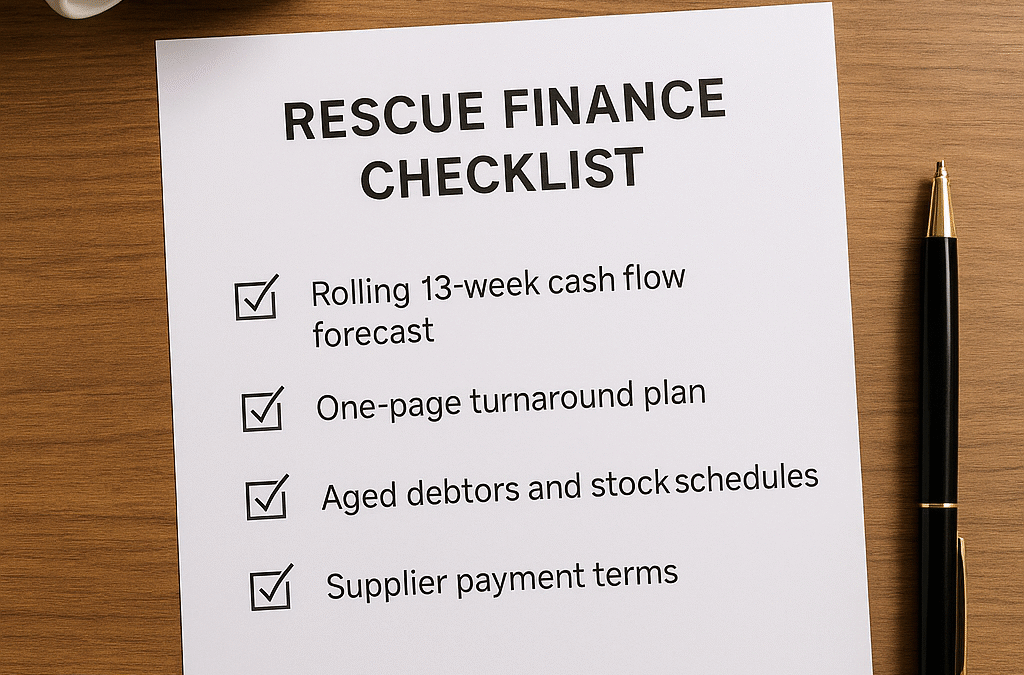
Takeaway Checklist
✅ Prepare a rolling 13-week cashflow forecast and highlight gaps
✅ Draft a one-page turnaround plan with clear milestones
✅ Reconcile and age your debtors and stock schedules
✅ Identify assets suitable for ABL (stock, debtors, plant)
✅ Approach lenders with proof of concept (e.g. signed customer contracts)
✅ Negotiate supplier payment terms before seeking new debt
✅ Document board minutes approving the finance strategy
✅ Engage a licensed insolvency practitioner early to review proposals
Further Reading & Resources
- HMRC Recovery Loan Scheme
- Insolvency Service – DIP Funding Guide
- Companies House – Charges Register
- BAILII – Asset-Based Lending Cases
- Earlier blog: Pre-Insolvency Health Check
Paul Brindley FCA
Licensed Insolvency Practitioner
Midlands Business Recovery
If you think rescue finance could save your business, let’s talk – confidentially and without obligation.
#RescueFinance #CashflowSolutions #TurnaroundLoans #ABL #InsolvencyAdvice #BusinessRecovery #DirectorSupport #MidlandsBusinessRecovery