
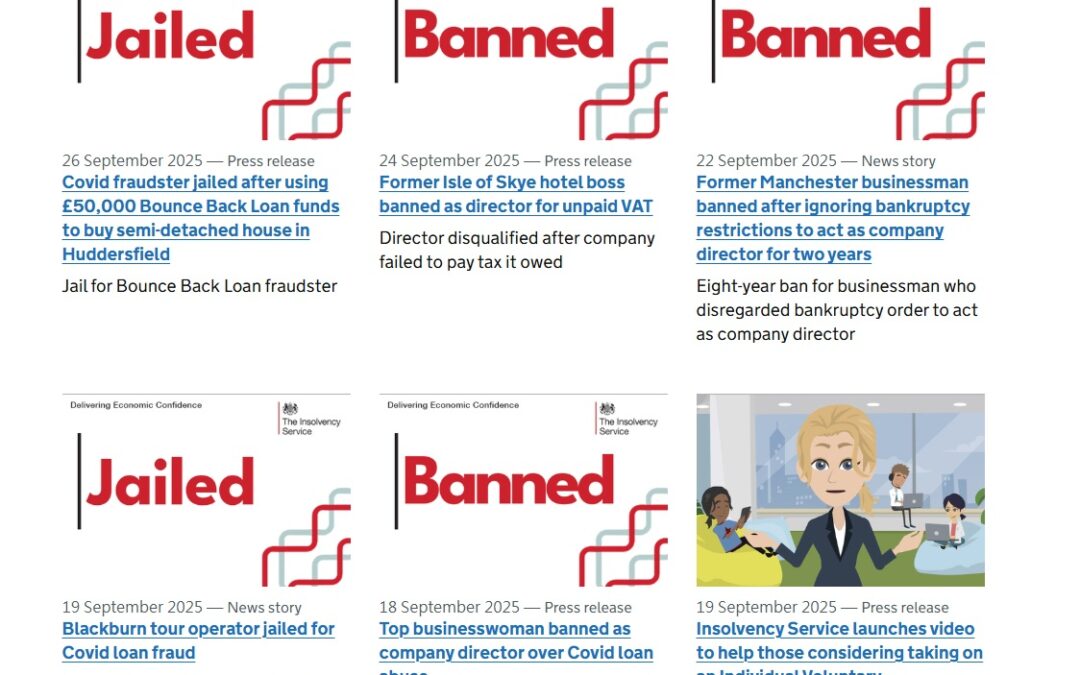
If you visit the Insolvency Service’s front page, you cannot miss the pattern. Story after story highlights directors jailed, disqualified, or forced to repay Bounce Back Loans (BBLs) and other Covid support that was taken out or misused. The sheer prominence tells us something important: tackling Covid loan abuse is now a defining priority for the Service.
But beyond the surface, this intense focus raises deeper questions. Has concentrating so heavily on Covid loan abuse left other types of fraud under-policed? And if so, what might that mean for the wider business community?
The Numbers: A Stark Shift in Priorities
The Insolvency Service’s April 2025 report paints a clear picture:
‘Of the 1,036 directors who were disqualified, 736 were for Covid loan abuse and the average length of a ban was eight years.’
– Insolvency Service, April 2025
That means 71% of all disqualifications last year were Covid-related.
Dave Magrath, Director of Investigation and Enforcement Services, emphasised:
‘Disqualifications for more than one thousand directors demonstrates the impact our investigative work is having. Whether it be Covid loan abuse or directors breaching disqualification restrictions, we are consistently tackling misconduct and bringing those responsible to account.’
– Insolvency Service, April 2025
The progression is striking:
-
2022–23: 459 director disqualifications for Covid support scheme abuse. (gov.uk)
-
2023–24: 1,222 disqualifications, of which 831 (68%) were Covid-related, average ban length nearly 10 years. (gov.uk)
-
2024–25: 1,036 disqualifications, of which 736 (71%) were Covid-related, average ban eight years. (gov.uk)
This represents a seismic shift in enforcement priorities. Where once disqualifications were spread across a wider range of offences – from failure to keep books, to trading to the detriment of creditors – now the statistics are dominated by Covid loan abuse.
Real Cases, Real Consequences
These are not just numbers. The Insolvency Service has been publicising cases that show both the scale of misconduct and the severity of sanctions.
Prison Sentences
-
Raashid Khan (Birmingham fireworks trader) – forged documents to secure a £50,000 loan, and withdrew over £60,000 after liquidation. Sentenced to 4 years in prison. (gov.uk)
-
Peter Connelly (video game composer, “Tomb Raider”) – inflated turnover to obtain a second loan and mis-declared eligibility. Sentenced to 16 months in prison and disqualified for 6 years. (gov.uk)
-
Junaid Dar (Birmingham fitness business) – applied for three loans and used funds for personal spending, including restaurants and a safari park. Sentenced to 20 months in prison, suspended for 18 months, plus 11-year disqualification. (gov.uk)
-
Irena Tokarczyk (Watford director) – claimed £50,000 then dissolved the company to avoid repayment. Sentenced to 18 months in prison, suspended, plus 3-year ban. (gov.uk)
Long Disqualification Bans
-
Anna Daroy (former Director-General of the Institute of Directors) – secured £100,000 in loans when only £50,000 permitted. 11-year ban. (gov.uk)
-
Joseph Harrison (Kent car dealer) – secured two loans totalling £90,000. 12-year ban, ordered to repay £38,295. (gov.uk)
-
Carl Barnes (Lincoln plumbing director) – dishonestly secured £47,500 loan. 11-year ban. (gov.uk)
-
Azizullrahman Akbari (London bakery) – overstated turnover to secure £50,000. 10-year ban. (gov.uk)
-
Ruxanda Guja (decorator) – applied for three loans totalling £145,000. 13-year ban plus £107,038 compensation order. (gov.uk)
-
Richard Oliver (council grant and Covid loan fraud) – falsely applied for business grants and loans totalling £145,000. 15-year ban (maximum). (gov.uk)
These examples demonstrate a clear willingness to use both custodial sentences and the full range of disqualification powers.
The Benefits of Focus – and the Risks
Benefits
-
Strong public message: Covid loan fraud will not be tolerated.
-
Restoring public confidence: taxpayers see misuse of crisis funds punished.
-
Deterrence: other directors will think twice before misusing public support schemes.
Risks
-
Resource imbalance: With 70%+ of disqualifications tied to Covid, is too little being done about other types of fraud?
-
R&D tax credit abuse: Fraudulent claims have cost HMRC billions — but enforcement headlines are few.
-
Consumer fraud and creditor abuse: Cases of mis-selling, phoenix companies, and deliberate non-payment of taxes may not be receiving equal weight.
-
Regulatory tunnel vision: The danger is that today’s “headline fraud” distracts from tomorrow’s scandal in the making.
Lessons for Directors
For directors and business owners, there are two clear lessons:
-
Covid loan misuse will not be forgotten. Even years later, cases are being investigated and sanctions imposed.
-
All misconduct carries risk. The Insolvency Service’s current focus may be on Covid, but history shows enforcement priorities shift. What seems under the radar today may be tomorrow’s priority.
Good governance, proper record-keeping, and honest declarations are non-negotiable.
A Broader Question of Balance
In my ‘40 Years in Insolvency – Let’s Talk Honestly’ series, I have raised questions about whether the profession has the right people, structures, and priorities. In my post on the identity crisis of insolvency, I asked whether we are truly balancing the competing demands of clients, creditors, and regulators.
The same question applies here: is the Insolvency Service striking the right balance? Covid loan abuse is rightly pursued, but what about R&D fraud, consumer protection, and other systemic abuses? Are they receiving enough focus, or are some fraudsters slipping through the net because the spotlight is elsewhere?
Conclusion: Progress – But Keep Perspective
The clampdown on Covid loan abuse is necessary, justified, and overdue. The cases and statistics prove the Insolvency Service is delivering real enforcement: bans of up to 15 years, compensation orders, and prison terms.
But we must guard against tunnel vision. Fraud against the taxpayer and the public takes many forms, and it would be a tragedy if, in solving one scandal, others are allowed to thrive unchecked.
Perhaps the real challenge for regulators is not simply to punish past misconduct, but to maintain the breadth of vision needed to prevent the next wave of fraud before it dominates the headlines.