
The Problem
AI is everywhere. From chatbots on shopping websites to tools generating essays for students, the technology has exploded into the mainstream. But in the rush to use AI, people often misunderstand what these systems are, how they differ, and what they can (and cannot) do. One of the most common misconceptions is that all AI is the same. It isn’t.
The Old Options
In the past, if you wanted to know anything about insolvency you had a choice between doing everything manually (time-consuming and costly), such as meeting up with an IP, or using generic software tools that failed to produce tailored output. If you wanted speed, you sacrificed accuracy. If you wanted accuracy, you sacrificed time. There was no middle ground.
Enter AI – But Not All AI Is Equal
Here’s where the distinction matters.
- Horizontal AI models are general-purpose. Think of ChatGPT or Google Gemini. They’re trained to do a bit of everything: write about cricket, compose a love poem, summarise a legal case, or produce a shopping list. They’re wide, but shallow – brilliant generalists, but not specialists.
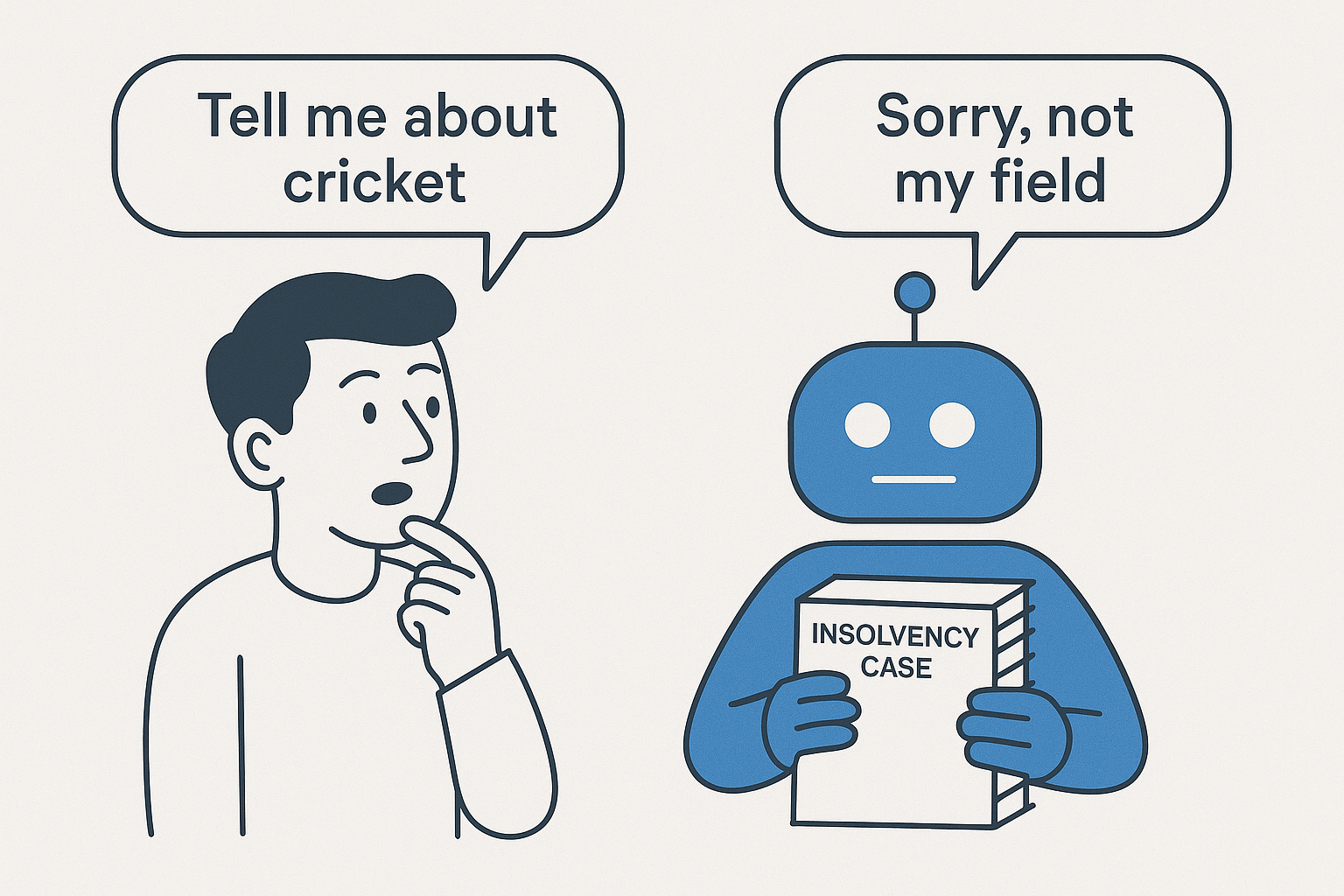
- Vertical AI models, by contrast, go deep into one industry or domain. They’re trained, fine-tuned, and restricted to excel in a specific area. That’s what VAi is: a vertical model for insolvency. Ask it to explain something technical about insolvency, draft an email, or check the advice you’ve been given – it’s in its element. Ask it about yesterday’s England cricket score, as one mischievous user did, and it quite rightly refuses. That’s not a bug, it’s a feature, and a very, very important one.
The Internet Question
Another frequent misunderstanding is about internet access. People assume that because an AI is clever, it must be able to pull live data from the web. Last week, for instance, a user asked VAi to write an article about the latest insolvency statistics. VAi politely declined.
Why?
Because that limitation is by design. Allowing unrestricted internet access risks contaminating the carefully curated data that VAi is trained on. The internet is full of speculation, bias, and – frankly – rubbish. Feed that into a specialist insolvency AI, and you risk undermining the reliability of its outputs.
In fact, VAi’s refusal to play ball shows strength, not weakness. It demonstrates that VAi has been built to protect integrity, accuracy, and trustworthiness. If you want gossip and hot takes, ask a horizontal AI. If you want insolvency-specific accuracy that you can use in a professional setting, ask VAi.
Conclusion
So, if you are asking yourself ‘Why doesn’t VAi know this?’ or ‘Why can’t VAi just Google that?’, remember: the best professional tools are designed to protect you from noise, not throw more of it at you. VAi is vertical, focused, and built for users who value speed, accuracy, and professional-grade outputs. Because in AI, as in insolvency, depth beats breadth every time.
If you have problems understanding how to use VAi, go to our videos, watching them will be a good investment of your time.