
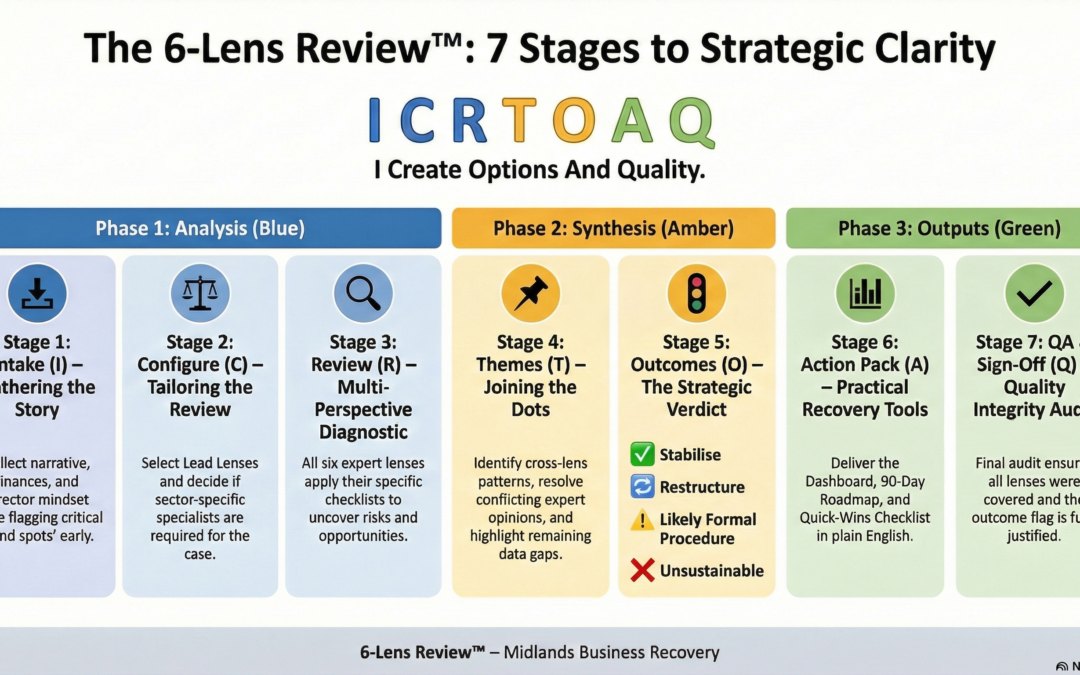
The full 6-Lens Review follows a structured 7-stage production process designed to provide a comprehensive diagnostic of a business in distress. It is remembered by the mnemonic I C R T O A Q (I Create Options And Quality).
The process is typically categorised into three phases: Analysis (Stages 1–3), Synthesis (Stages 4–5), and Outputs (Stages 6–7).
Stage 1: Intake (I)
This initial stage focuses on gathering the narrative and factual background of the company. Key activities include:
- Gathering Background: Collecting financial data, stakeholder profiles, and information on the director’s current mindset.
- Early Risk Screening: Identifying “blind spots” early – such as missing accounts or incomplete creditor details – to ensure the diagnostic is grounded in reality.
Stage 2: Configure (C)
In this stage, the review is tailored to the specific needs of the business:
- Selecting Lead Lenses: One or two “Lead Lenses” are chosen to chair the process based on the crisis shape (e.g., Turnaround and Technician for cash-critical SMEs or Strategist and Litigator for complex groups).
- Sector Specialists: The team decides if a specialist (e.g., for healthcare or construction) is required to add industry-specific context.
Stage 3: Review (R)
The core analysis occurs as all six expert lenses apply their specific checklists to the case:
- Strategist: Long-term viability and leadership.
- Turnaround: Short-term cash control and costs.
- Litigator: Legal risks, guarantees, and disputes.
- Empath: People, wellbeing, and ethics.
- Technician: Statutory compliance and duties.
- Innovator: Alternative models and new technology.
Stage 4: Themes (T)
This stage involves pulling together cross-lens findings to identify patterns:
- Conflict Resolution: The team explicitly notes conflicts between lenses – such as where short-term survival needs clash with long-term strategic goals – and highlights remaining blind spots.
Stage 5: Outcomes (O)
The expert panel synthesises all findings to assign a single Outcome Flag that defines the recommended path forward:
- The Four Flags: ✅ Stabilise and trade through, 🔁 Restructure informally, ⚠️ Likely formal procedure, or ❌ Unsustainable model.
Stage 6: Action Pack (A)
Findings are converted into practical, decision-making tools for the client:
- Dual-Layer Reporting: Delivering a plain-English Director Report and a technical Adviser Report.
- Practical Tools: Inclusion of the Traffic-Light Dashboard, 90-Day Roadmap, and Quick-Wins Checklist.
Stage 7: QA & Sign-Off (Q)
The final stage is a rigorous quality audit to ensure process integrity:
Final Check: The practitioner confirms all six lenses were addressed, the outcome flag is justified, blind spots are documented, and sector specialists were considered where necessary.