
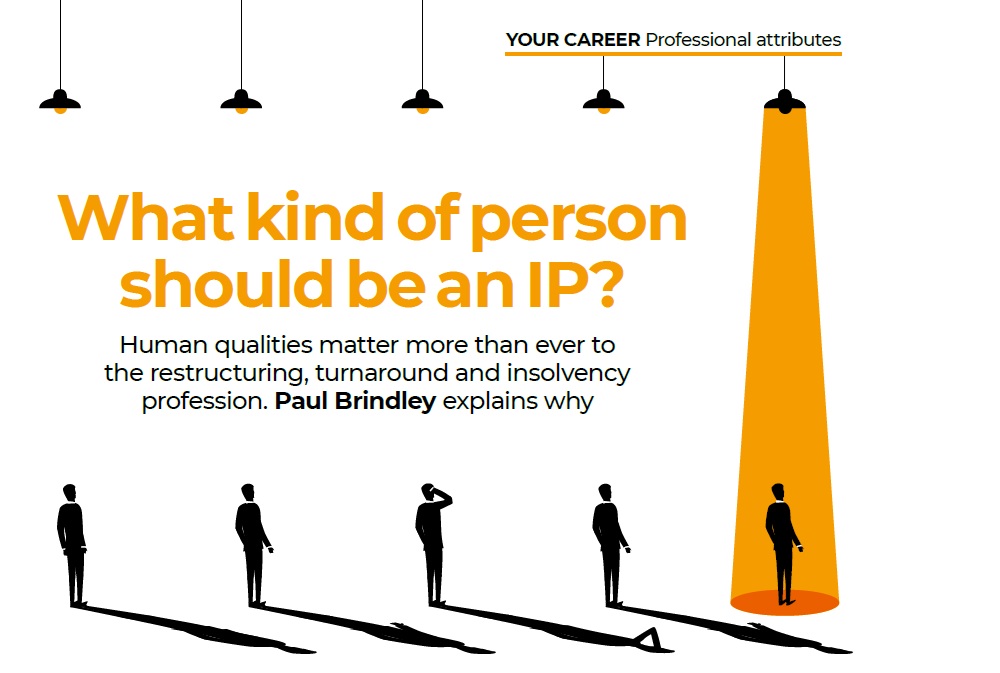
So what Kind of Person Should Be an IP?
Not just technically good…
Not just efficient…
Not just compliant…
That may sound provocative, but I think it needs saying.
I’m pleased to say that my article, “What kind of person should be an IP?”, appeared in the Spring 2026 edition of Recovery magazine and is reproduced on my website with the permission of R3 Association of Business Recovery Professionals and Think.
The article asks a simple question. But not a comfortable one.
What sort of person should be doing this job now?
Because insolvency work is not just about rules, reports and procedures. It is about people under pressure, businesses in trouble, difficult conversations, and decisions that can shape lives, jobs and futures.
That calls for more than technical competence alone.
This profession asks a lot of people
Insolvency has never been easy work.
It involves law, money, deadlines, conflict, regulation, investigation, commercial judgement and, very often, distressed people who have run out of road.
That has always been true, but the environment around the profession is getting harder, not easier. Expectations are changing, technology is changing, clients are changing and staff expectations are changing too. And yet some parts of the profession still behave as though technical accuracy is the whole game.
It isn’t.
Why?… because when a director comes to us at one of the worst moments of their business life, they are not just bringing a balance sheet problem. They are often bringing fear, shame, confusion, exhaustion and pressure from every angle.
A good IP needs to be able to handle that reality properly.
Technical skill matters… but it is not the full answer
Let’s be clear, this is not an argument against technical standards. Far from it.
An insolvency practitioner has to know the law, understand the process, apply judgement carefully and do difficult work properly.
But technical skill on its own is not enough.
You can be clever and still give poor advice.
You can be efficient and still lack judgement.
You can be fully compliant and still leave people feeling unheard, mishandled or pushed down a route that suits the adviser better than the client.
That is part of the reason I wrote the original article.
We should be asking better questions
When people talk about what makes a good IP, the discussion often starts and ends with qualifications, compliance and case handling.
Important? Yes.
Enough? No.
We should also be asking:
- Can this person listen properly?
- Can they stay calm under pressure?
- Can they deal with vulnerable or distressed clients with decency?
- Can they challenge bad practice?
- Can they recognise when liquidation is not the right answer?
- Can they make difficult calls with integrity when there is no easy option?
Because that is what the job actually looks like in the real world.
Integrity is tested when it is inconvenient
It is easy to talk about ethics in the abstract.
It is harder when the right course is awkward, less profitable, slower, or cuts across the way things have “always been done”.
That is where character starts to matter.
For me, the profession should value people who do the right thing even when it is inconvenient. Not just when it is easy, not just when someone is watching, and not just when the regulations spell it out in black and white.
That is one of the central themes in the article.
Burnout is not a badge of honour
There is another side to this that does not get enough attention.
Too many people in the insolvency profession are running on empty as a result of heavy caseloads, long hours, emotional strain, commercial pressure, endless compliance and quiet exhaustion.
Some firms still wear that as a badge of honour or seriousness. I think that is a mistake.
Tired people do not make the best decisions. Overstretched people are less likely to listen well, think clearly, spot risks early, or deal with clients in the way they deserve.
So this is not just a wellbeing issue, it is a quality issue, a judgement issue, a professional standards issue.
If we want better outcomes, we need healthier working habits and healthier firms.
What behaviours are we rewarding?
This is where things get uncomfortable.
Professions tend to become what they reward.
So what are we rewarding?
Speed? Billing? Case volume? Technical box-ticking?
Or are we also rewarding wisdom, perspective, empathy, restraint, courage and judgement?
Because a profession can drift. Slowly at first. Then all at once.
It can end up promoting the wrong strengths without really meaning to.
That is another reason I wanted to put these thoughts into print.
We need more than technicians
The profession absolutely needs strong technicians. But it does not need technicians alone.
It needs people who can think strategically. People who understand business reality, who can communicate with humanity, who can adapt, who are open to better tools and better ways of working, who remember that outcomes matter, not just process.
In other words… we need rounded professionals, not just capable file handlers.
That may sound blunt, but I think it is true.
Read the full article and tell me what you think
My article, “What kind of person should be an IP?”, appeared in the Spring 2026 edition of Recovery magazine and is reproduced on my website with the permission of R3 Association of Business Recovery Professionals and Think.
I’d be grateful if you would read it.
And I would genuinely welcome your comments on it… whether you agree with it or not.
If you agree with it, say so. Conversely, if you think I have got it wrong, say so. And if you think I have missed something important, I would like to hear that too.
There is no point pretending this is a settled issue. It isn’t. And the profession will be better served by honest discussion than polite silence.
#Insolvency #InsolvencyPractitioner #BusinessRecovery #Restructuring #Turnaround #R3 #RecoveryMagazine #ProfessionalEthics #Leadership #BusinessRecoveryProfession