
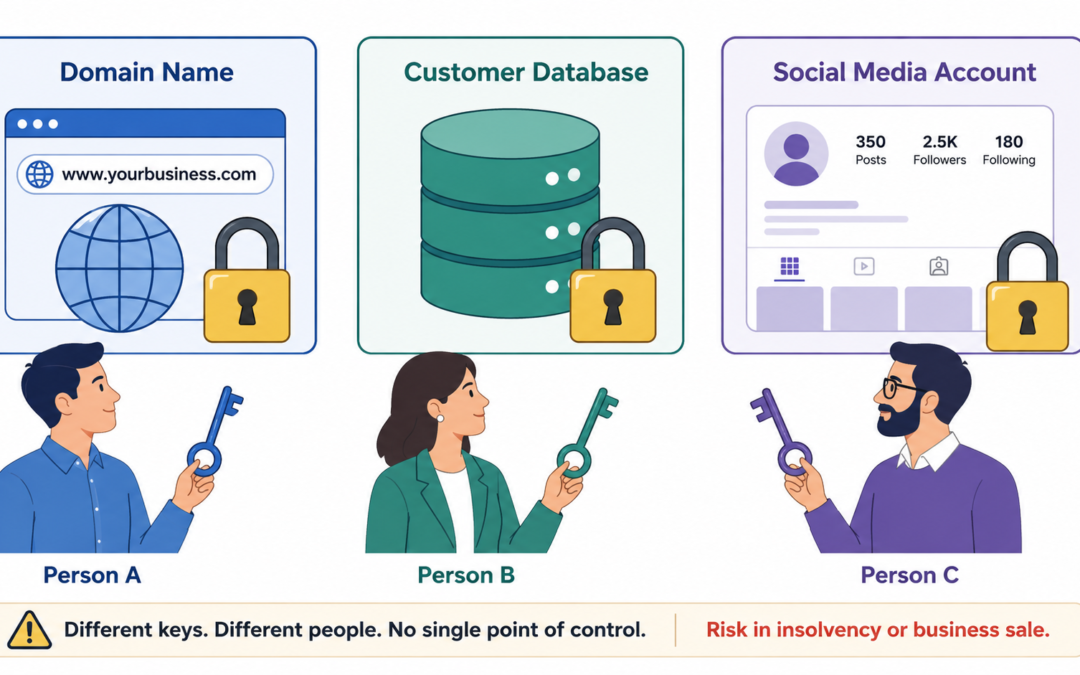
When directors think about company assets, they usually picture the obvious things.
Cash. Vehicles. Machinery. Stock. Debtors.
But some of the most valuable assets in today’s modern business don’t sit on the balance sheet quite so neatly.
The company website.
The domain name.
The customer database.
Email addresses.
Social media accounts.
Software.
Photographs, drawings, brochures and other intellectual property.
When a company gets into financial difficulty, these assets can easily be overlooked. Worse still, directors sometimes discover far too late that what they thought belonged to the company is actually registered in somebody else’s name.
Start with the website
A website is not one single asset.
It may consist of:
-
domain names;
-
website code;
-
text and photographs;
-
logos and branding;
-
customer enquiry data;
-
hosting arrangements;
-
software licences;
-
email addresses linked to the domain.
Each element may have a different legal owner.
The fact that the company paid for the website does not automatically answer every ownership question.
Who owns the copyright?
Copyright in material created by an employee in the course of their employment will normally belong to the employer, subject to any agreement to the contrary.
But outsourced work needs more care.
If a freelance designer, photographer or web developer created material for the company, ownership may depend upon the contract.
An assignment of copyright generally needs to be in writing and signed by or on behalf of the person assigning it.
That means paying an invoice for a new website is not always the same as owning every intellectual property right within it.
This matters when a purchaser wants the whole digital package as part of a business sale.
The domain name
The domain name may be one of the company’s most important assets.
But who is it registered to?
I have seen situations where a business has traded under the same domain for years, only to discover that the registration is actually in:
-
a director’s personal name;
-
the name of the original web designer;
-
a former employee;
-
another group company.
That creates an immediate problem.
If the company does not own or control the registration, the liquidator or administrator may not be able simply to transfer it to a purchaser.
Directors should therefore check:
-
the registrar;
-
the registrant details;
-
the renewal date;
-
the account login;
-
the recovery email address;
-
who controls two-factor authentication.
A domain worth thousands of pounds can become effectively useless if nobody can access the account.
What about the customer database?
A customer database can have substantial commercial value.
It may contain:
-
customer names;
-
contact details;
-
purchasing history;
-
pricing information;
-
enquiries;
-
marketing permissions;
-
contract records.
The database may also attract database rights depending upon how it was created and maintained. The UK Database Regulations provide protection for qualifying databases where there has been substantial investment in obtaining, verifying or presenting their contents.
But there is another issue…
personal data.
A liquidator cannot simply treat personal information in the same way as a pallet of stock.
The sale or transfer of customer data must comply with UK data protection law.
The ICO has specifically addressed insolvency situations and makes clear that where personal data is being transferred as part of a business sale, the parties must consider the lawful basis for the transfer, transparency and the expectations of the individuals concerned.
That does not mean customer databases cannot be sold.
They frequently can. but it does mean the transaction needs to be handled properly.
The marketing list may be different
This is often overlooked.
A database of existing customers is not necessarily the same thing as a list of people who have consented to receive marketing communications.
A purchaser may acquire historical customer records but still face restrictions on how those individuals can subsequently be marketed to.
So before anybody values the database, establish what it actually contains.
There is a big difference between:
-
20,000 historic customer records;
-
20,000 active customers;
-
20,000 people who have properly consented to marketing.
They are not commercially equivalent.
What about social media?
The same practical problem arises with:
-
LinkedIn;
-
Facebook;
-
Instagram;
-
X;
-
YouTube;
-
Google Business profiles.
Who owns the account?
Who knows the password?
Whose mobile phone receives the authentication code?
A company can spend years building an audience and still find that the account is controlled by a former marketing employee.
That needs sorting before a sale, not afterwards.
And email?
A company’s email domain can contain more than correspondence.
It may contain:
-
orders;
-
quotations;
-
contracts;
-
customer relationships;
-
supplier information;
-
debt collection evidence;
-
intellectual property;
-
evidence relevant to directors’ conduct.
Do not shut the email system down simply because the company has stopped trading.
Preserve it first.
The same goes for cloud storage and messaging systems.
Why this matters before insolvency
Digital assets may materially increase what a business is worth.
A purchaser may be interested in:
-
the trading name;
-
domain;
-
website;
-
telephone number;
-
customer relationships;
-
social media following;
-
order history;
-
intellectual property.
Individually, some may have limited value.
Together, they may represent the goodwill of the business.
If nobody has checked ownership, access and transferability, a sale can fall apart at the last moment.
What directors should prepare
Before an insolvency practitioner is appointed, prepare a digital asset schedule showing:
-
domain names;
-
registrars;
-
website hosting;
-
ownership of website content;
-
customer databases;
-
CRM systems;
-
social media accounts;
-
email systems;
-
software licences;
-
cloud storage;
-
trademarks;
-
photographs and designs;
-
login and recovery arrangements;
-
expiry and renewal dates;
-
any restrictions on transfer.
Do not simply hand over a list of passwords.
Record what each system is, who owns it and what rights the company actually has.
Takeaway checklist
-
Is the domain registered to the company?
-
Who owns the website copyright?
-
Were freelance intellectual property rights properly assigned?
-
Who controls the hosting account?
-
Is the customer database transferable?
-
Does it contain personal data?
-
What marketing permissions exist?
-
Who controls the social media accounts?
-
Are email and cloud records preserved?
-
Are software licences transferable?
-
Could any digital asset increase the value of a business sale?
-
Have ownership disputes been identified before insolvency?
Final thought
The assets that disappear most easily are often the ones nobody can physically touch.
A lathe is difficult to lose.
A domain name can disappear because somebody forgot to renew it.
A customer database can become unusable because nobody thought about data protection.
A social media account can walk out of the door with an employee’s mobile phone.
So when financial problems begin, don’t just count the machinery.
Map the digital assets as well.
They may be worth more than you think.
#CompanyInsolvency #DigitalAssets #CustomerDatabase #IntellectualProperty #BusinessSale #DirectorsDuties #BusinessRescue