
If you’re a director trying to work out what the law actually expects when you apply to strike a company off using DS01, start with statute, not folklore.
One subsection of the Companies Act 2006 does more work here than most people realise.
The statutory anchor: Companies Act 2006 s1006(1)
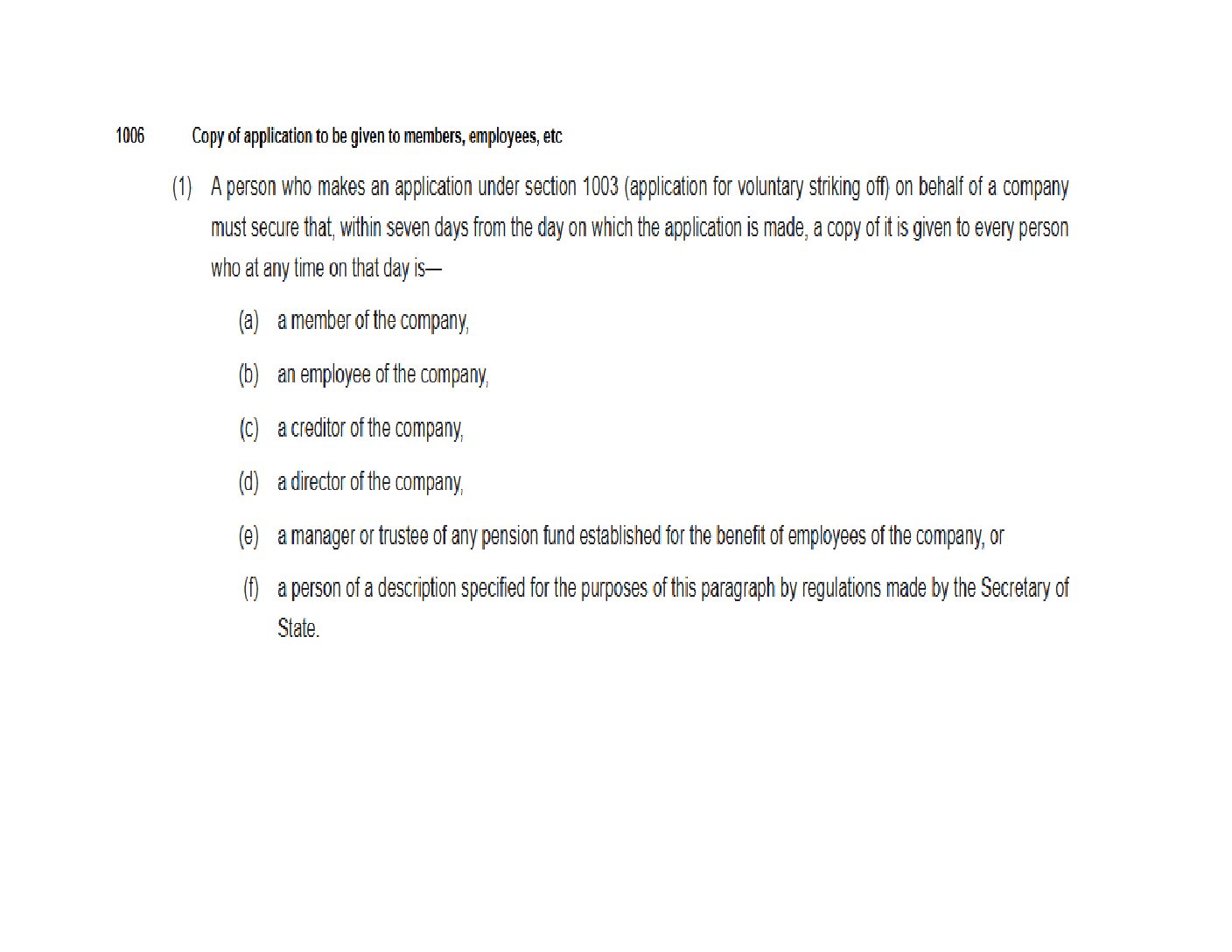
Section 1006(1) – see the image at the top of this blog – requires the person making the voluntary strike-off application to ensure that a copy of the application is given (within seven days) to specific groups … including:
- employees … subparagraph (b)
- creditors … subparagraph (c)
That is Parliament saying: you don’t get to do this quietly. If strike-off is being used, the people who might be affected must be told … and they get the chance to object.
Why that wording matters in practice
The Act says a creditor and an employee.
Not ‘former creditor’. Not ‘former employee’.
So, on a plain reading, if on the day the DS01 is made a person is a creditor or an employee, they must be served.
That captures the real world:
- a trade supplier owed money for goods or services
- HMRC for taxes owed
- a landlord owed rent
- an employee who could be owed wages, holiday pay, pay in lieu of notice, or redundancy
- And so on.
And the statutory logic is straightforward:
- the DS01 is served
- the creditor or employee can object
- if they feel they need to, they can escalate (including, in some circumstances, a winding-up petition)
So the Act does not pretend that every DS01 relates only to a clean, dormant, debt-free shell. It anticipates mess.
What this implies … and why it makes people uncomfortable
Here’s the inference many in the market avoid saying out loud.
If statute requires service on creditors and employees, Parliament plainly envisaged that a company might apply to strike off even when those categories exist … provided the statutory requirements are met and the affected parties are told.
That does not mean DS01 is always appropriate. It does not mean directors can use strike-off as a back door to avoid accountability. It certainly doesn’t mean misconduct can be swept under the carpet.
But it does mean something crucial:
A CVL is not automatically the only lawful route in every small, low-asset, low-debt scenario.
And once you accept that, a serious ethical question appears.
The advice problem: when ‘default CVL’ becomes self-serving
Many directors who ask … ‘What do I do with this insolvent company?’ … are steered to a creditors’ voluntary liquidation as the default.
Often that’s correct.
But there’s a band of cases that sits in the awkward middle:
- minimal or no assets
- liabilities that are real but modest
- no prospect of a dividend
- directors already under intense financial and personal strain
- the only way a CVL happens is if the director pays personally … often by borrowing
In that zone, the director is not choosing between two equally accessible statutory options.
They are choosing between:
- paying for a private professional process, or
- using a Companies Act process that is cheaper but requires transparency and creates an opportunity for objection. £13 online, £18 offline.
If an adviser presents only the more expensive route as the one to follow, without properly explaining the alternatives and the trade-offs, that is not just a style issue. It is a conflict issue.
Because the adviser’s firm earns the fee, one that is a good many times that of the alternative.
Sometimes it is a justified fee. Sometimes it is an essential fee. But the conflict exists, structurally, and pretending it doesn’t helps nobody.
The personal insolvency comparison: DROs prove the system can be proportionate
Personal insolvency law is refreshingly honest about one thing.
People with low debts and no meaningful assets should not be forced into expensive, heavy procedures simply because they’re poor.
That is what Debt Relief Orders (DROs) were built for.
And crucially … the thresholds for DROs are not ‘tiny’ any more. They have been actively managed over time, and the direction of travel is obvious.
A quick history of DRO debt limits and fees
- When DROs were introduced in 2009, the debt cap was £15,000.
- It rose to £20,000 from 1 October 2015.
- It rose again to £30,000 from 29 June 2021.
- It rose again to £50,000 from 28 June 2024. Yes £50,000!
- The application fee used to be £90, but that fee was removed from 6 April 2024, making DROs free. Yes, free!
That is regular, active management by government. Not a one-off. Not a forgotten corner of the system.
And it shows something important: when the state believes a low-cost route is socially necessary, it maintains it, adjusts it, and makes it workable.
Corporate insolvency: the gap that’s been staring at everyone for decades
Now look at corporate insolvency at the micro end.
The UK has an enormous population of small businesses. The economy has shifted towards micro and owner-managed companies, and a very large proportion have no employees at all.
So the economy has changed. The corporate framework … largely hasn’t.
There is no true corporate equivalent to a DRO:
- no statutory debt and asset thresholds for a micro-company wind-down
- no Official Receiver-run, low-cost corporate closure procedure for the routine no-asset case
- no ‘small company relief’ mechanism designed for owner-managed companies that fail quietly and simply
- Yet there has been over 15 years of opportunity missed to create one – the Companies Act 2006 was brought into force over a three year period to October 2009.
Instead, directors are often told they ‘need’ a CVL … even where there are no assets to realise, no prospect of a dividend, and the director is already financially squeezed.
This matters because in low-asset cases the cost burden often shifts from the failed company to the director personally … even though the director has often lost their only meaningful income source.
Sometimes directors borrow to pay liquidation costs.
If that is the only way out being presented, you have to ask whether the advice is proportionate.
Is it fair … or is it just bad advice?
In some cases a CVL is absolutely the right route. For example:
- there are employee claims and the process needs to interact properly with statutory schemes
- there are transactions that may need investigation or recovery
- there are director conduct issues where formal scrutiny is appropriate
- there are secured creditor dynamics requiring control and realisations
- DS01 restrictions apply and strike-off is not available
But in the routine ‘no assets, modest debts, no misconduct flags’ case, telling a stressed director to borrow personal money to fund a process that delivers no chance of a creditor return demands a clear justification.
If the justification is genuinely evidence-based and explained … fair enough.
If the justification is … ‘this is just what everyone does’ … that’s weak.
And if the cheaper legal route is quietly omitted because it doesn’t generate a fee, that crosses a line. That is not trusted adviser behaviour.
The rallying cry: a statutory micro-company wind-down, overseen by the Official Receiver
This isn’t about letting directors dodge liabilities … it’s about creating a proportionate, transparent, safeguard-led route with proper notification and a clear objection mechanism for creditors and employees.
This is where the profession should stop murmuring and start pushing.
What’s needed is an additional corporate procedure designed for micro companies, something like a ‘Small Company Relief Order’ (call it what you like), with features such as:
- Eligibility thresholds set in law and reviewed regularly (like DROs):
- maximum unsecured debt
- maximum asset value
- sensible exclusions for fraud, abuse, or serious misconduct
- Mandatory creditor notification baked in, aligned with the transparency logic of s1006
- A clear objection window with defined escalation routes
- Official Receiver oversight as the default administrator
- Minimal up-front professional fees for the director in the routine no-asset case
- Straightforward online application, with evidence-based declarations
- Real consequences for abuse, because any simplified route will be gamed if it isn’t firm
This isn’t anti-IP. It’s pro-proportionality.
It frees up professional time for cases where professional intervention actually changes outcomes … and it stops the lowest-value cases becoming a fee-driven funnel.
Why hasn’t it happened?
There are several plausible reasons, and none of them are flattering.
- Institutional inertia
Policy bandwidth is limited. Big-ticket collapses, fraud (especially Covid relatred fraud), and misconduct dominate attention. - Fear of abuse
A simplified corporate closure could become a ‘debt dumping’ tool without tight design. - Misaligned incentives
Some parts of the insolvency market benefit from the status quo. Not all firms. Not most IPs. But enough that quiet resistance is predictable. - Lack of a worked proposal
The profession talks, but hasn’t consistently put a detailed, abuse-resistant model on the table loudly enough for government to pick up and run with.
That last one is on the profession.
Open letter to the Chief Executive of the Insolvency Service
Dear Chief Executive,
I’m writing publicly because this issue is structural, longstanding, and increasingly unfair.
Personal insolvency law recognises that people with low debts and no assets need a proportionate route. Debt Relief Orders exist for precisely that reason, and the Insolvency Service has actively managed eligibility in recent years … raising thresholds and removing barriers. The debt cap has moved from £15,000 at inception to £20,000, then £30,000, and most recently £50,000. The £90 fee has been removed, making the process free.
Corporate insolvency faces a similar reality at the micro end, but the equivalent mechanism does not exist.
Many owner-managed limited companies fail with modest debts, no realisable assets, and no realistic prospect of funding a liquidation from the estate.
In those cases, directors are routinely told to fund a CVL personally … often by borrowing … despite limited creditor benefit and despite there being a statutory voluntary strike-off route which requires service on creditors and employees, thereby creating a built-in opportunity for those parties to object.
This is not an argument against formal insolvency where it is needed. It is an argument for proportionality where it is not.
Please include within the Insolvency Service’s forward programme a proposal for a threshold-based, low-cost corporate wind-down procedure for micro companies … overseen by the Official Receiver … transparent, abuse-resistant, and affordable.
The professional insolvency market should not be the only exit route for directors who have already lost their income and have no assets to realise. That is not access to justice. It is a market solution filling a legislative gap.
Open a formal consultation on a ‘Small Company Relief Order’ style process. Invite the profession, creditors, Companies House and other stakeholders. Publish options. Put numbers against them. Move this from an interesting idea to a genuine legislative proposal.
Directors deserve a proportionate route.
Creditors deserve transparency.
Confidence in the system depends on it.
Here’s a link to my blog in which I explore this:https://midlandsbusinessrecovery.co.uk/2026/02/13/ds01-creditors-and-the-awkward-truth-nobody-wants-to-say-out-loud/
I’d be very happy to engage in dialogue with you on this important issue.
Yours faithfully,
Paul Brindley FCA
Licensed Insolvency Practitioner
A call to the profession
If insolvency practitioners want to be seen as trusted professionals rather than paid gatekeepers, the profession needs to lead this reform, not avoid it.
That means:
- acknowledging the structural conflict in low-asset cases
- committing to full, options-based advice
- pushing for a statutory micro-company procedure that stops directors being nudged into borrowing for a process they cannot afford … and that often delivers little stakeholder value
If the profession doesn’t do this, someone else will write the narrative. And it won’t be kind.
Hashtags
#Insolvency #CompaniesAct2006 #DS01 #CorporateInsolvency #Ethics #DebtReliefOrders #SmallBusiness #DirectorsDuties #InsolvencyService #OfficialReceiver #InsolvencyProfession