
If you’re considering closing a solvent company through a Members’ Voluntary Liquidation, we need to look at Business Asset Disposal Relief in a calm, factual way…
There is a published plan.
But that doesn’t mean it’s the end of the story.
The Phased Increases Are Real and Public
The government announced a staged increase in BADR rates at the Autumn Budget 2024. It is reflected in official HMRC guidance.
Under that timetable, you would be paying:
-
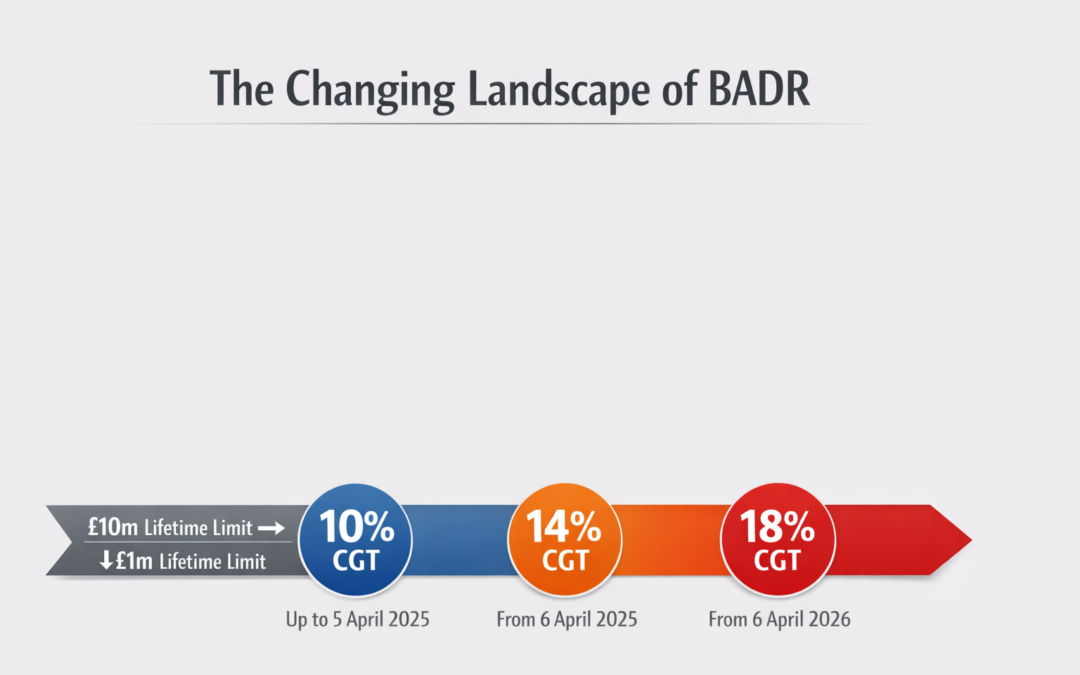
10% CGT on qualifying disposals up to 5 April 2025
-
14% CGT from 6 April 2025
-
18% CGT from 6 April 2026
You can see the current position here: https://www.gov.uk/business-asset-disposal-relief
And the wider CGT rate changes here: https://www.gov.uk/government/publications/changes-to-the-rates-of-capital-gains-tax
So this isn’t rumour. It’s legislated policy.
If you complete a qualifying MVL distribution before 6 April 2026, the rate is 14%. After that date, it is scheduled to be 18%.
The 10% Rate Is Gone … But It Tells a Story
We’re no longer in the 10% world. That window closed on 5 April 2025.
But it’s important to mention it, because it shows the direction of travel.
Not long ago, BADR meant:
-
A £10 million lifetime limit.
-
A 10% CGT rate.
Today it means:
-
A £1 million lifetime limit.
-
A 14% rate rising to 18% in April 2026, just 2 months’ time.
That’s not a small adjustment. That’s a steady reduction in generosity over time.
Whether you agree with the policy or not, the pattern is clear.
What Actually Matters Now
The meaningful comparison today is not 10% versus 14%. That ship has already sailed.
The real comparison is:
-
14% if you complete before 6 April 2026
-
18% if you complete on or after 6 April 2026
On a £1m qualifying gain, that’s a £40,000 difference.
On £500k, it’s £20,000.
On £250k, it’s £10,000.
That’s not noise.
If an MVL is already likely in the next 12–24 months, that differential deserves attention.
Is 18% the Final Resting Point?
Here’s the honest answer…
There is no published guarantee that 18% from April 2026 is the permanent rate.
Governments can change:
-
Rates.
-
Lifetime limits.
-
Qualifying conditions.
-
Anti-avoidance provisions.
We can plan confidently up to April 2026 because that timetable has been announced.
Beyond that, there are no assurances.
And when public finances are tight, capital taxes are always within reach.
This Is Not About Panic
An MVL must be commercially appropriate. The company must be solvent. You must qualify for BADR. You must consider the Targeted Anti-Avoidance Rule and future trading intentions.
This is not about forcing liquidation where it doesn’t belong.
It is about visibility.
If your company:
-
Has ceased trading or is winding down,
-
Holds significant retained profits,
-
Forms part of your retirement planning,
… then the tax trajectory is now visible on the calendar.
You can choose to act within it. Or drift into the next step.
Planning Means Control
You built the business. You carried the risk. You paid the corporation tax year after year.
The final extraction of value should be deliberate.
14% is current.
18% is scheduled.
And history shows that reliefs can tighten again.
If an MVL is already on your horizon, the sensible step is to review the numbers now and decide whether timing before April 2026 makes commercial sense.
Not because anyone is shouting.
But because the calendar is.
#MVL #BusinessAssetDisposalRelief #BADR #CapitalGainsTax #CompanyExit #TaxPlanning #SolventLiquidation #MidlandsBusinessRecovery