
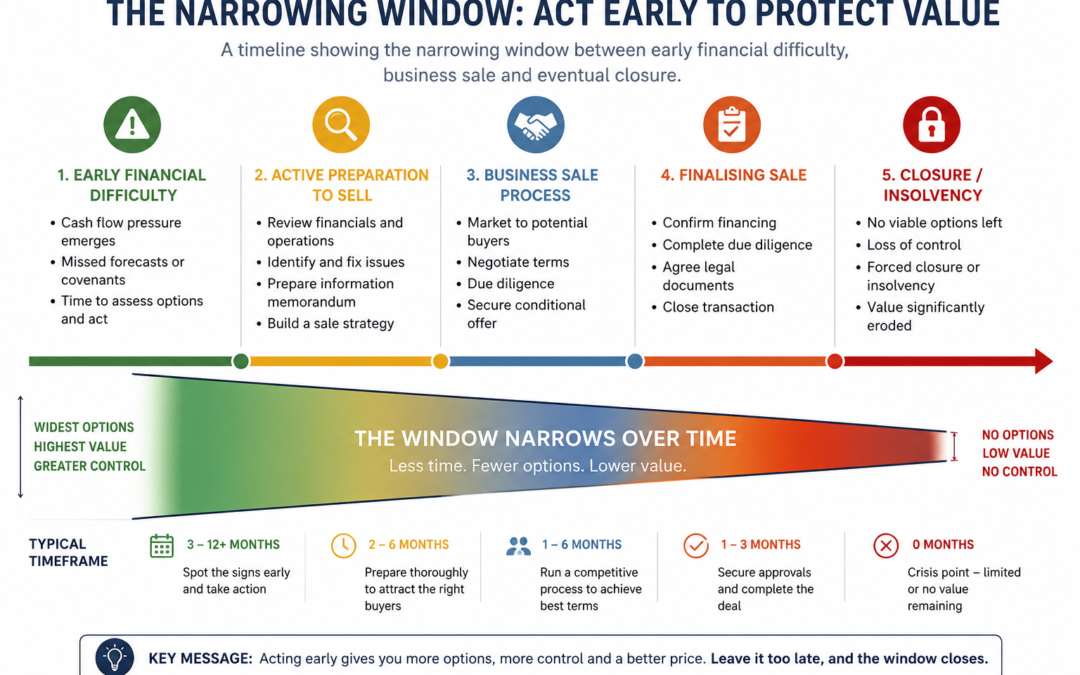
When a company is struggling, directors often hope a sale of the business will solve the problem.
And sometimes it can!… Because a sale may preserve jobs, keep customers supplied and produce a better result for creditors than simply shutting the doors.
But there’s a catch…
A distressed business sale moves quickly.
I’ve seen potentially good deals become much harder than they needed to be because basic information wasn’t ready. The buyer loses confidence, advisers spend precious time chasing documents and, while all this is happening, cash continues to disappear.
If you are looking to sell your company may, like with decorating, preparation really matters.
Firstly… understand exactly what you’re actually selling
A company and its business are not the same thing.
A buyer might acquire the shares in the company. But where insolvency is approaching, it’s often more likely that the buyer will acquire some or all of the underlying business and assets instead.
That might include:
-
plant and machinery;
-
stock;
-
work in progress;
-
customer contracts;
-
intellectual property;
-
website and domain names;
-
telephone numbers;
-
goodwill;
-
order book;
-
trading name.
Some things may not belong to the company at all…leased machinery, hire purchase equipment and goods subject to valid retention of title claims need identifying separately.
Get this wrong and you can end up offering a buyer assets that you don’t own.
Get the financial information up to date
A buyer needs to understand what they’re buying.
That doesn’t necessarily mean producing beautiful management accounts. In a distressed situation, speed is often more important than presentation.
But the numbers must be credible.
If I were a buyer, I’d want to see:
-
recent management accounts;
-
current bank position;
-
aged debtors;
-
aged creditors;
-
HMRC liabilities;
-
payroll and pension position;
-
stock and work in progress;
-
current order book;
-
recent monthly turnover;
-
gross margins;
-
cash flow forecast.
If the accounts say debtors are £300,000 but £120,000 hasn’t moved for a year, say so.
Bad news supplied upfront doesn’t usually kill a distressed sale.
But discovering bad news late does.
Prepare an asset list
Produce a sensible schedule of the assets.
For machinery, include descriptions, serial numbers, approximate age and location.
Separate:
-
company-owned assets;
-
leased assets;
-
hire purchase;
-
assets subject to finance;
-
assets belonging to directors or connected companies;
-
customer-owned equipment.
If valuations are available, include them.
If not, don’t invent values. Obtain proper advice.
Contracts can make or break the deal
A business may depend heavily upon a handful of customers.
The buyer will want to know:
-
what contracts exist;
-
how long they have left;
-
whether they can be assigned;
-
whether customer consent is required;
-
whether insolvency triggers termination rights;
-
whether there are change-of-control provisions.
The same applies to important supplier agreements, licences, leases and agency arrangements.
A £2 million order book is much less attractive if none of it can transfer.
Employees need early consideration
Employees cannot simply be treated as another asset.
Where a business transfers, the Transfer of Undertakings (Protection of Employment) Regulations 2006, usually called TUPE, may apply.
That can mean employees transfer automatically to the purchaser together with associated rights and liabilities.
There are also information and consultation obligations.
Don’t leave the employee position until somebody has already agreed the sale price.
It needs considering as part of the deal from the beginning. And that often means bringing in an experienced HR expert (we can introduce you to one, if needed)
Who owns the intellectual property?
Check:
-
trademarks;
-
trading names;
-
websites;
-
domains;
-
designs;
-
drawings;
-
software;
-
photographs;
-
customer databases.
Make sure the company actually owns what everyone assumes it owns.
This is particularly important where founders, directors, former employees or external designers created material in the early days of the business.
Property needs its own workstream
If the company occupies leased premises, find the lease.
Check:
-
rent arrears;
-
remaining term;
-
break clauses;
-
assignment provisions;
-
landlord consent requirements;
-
rent deposit;
-
guarantees.
A purchaser may want the factory but not the lease.
Or it may want the business only if the landlord agrees to an assignment.
Either way, you need to know early.
Directors must be careful about connected-party sales
A director may genuinely be the best person to buy the business.
That doesn’t make the transaction improper.
But it does mean the process needs particular care.
If the company is insolvent, directors must have regard to creditors’ interests. The nearer the company gets to unavoidable insolvency, the greater the weight that must be given to those interests. That principle was examined in detail by the Supreme Court in BTI 2014 LLC v Sequana SA.
A connected purchaser should not receive favourable treatment simply because they already know the business.
Proper valuation, marketing where appropriate, negotiation and a clear record of the decision-making process matter.
Don’t forget the practical information
This sounds mundane, but it can stop a transaction dead.
Prepare details of:
-
insurance;
-
utilities;
-
licences;
-
key passwords and system access;
-
bank facilities;
-
finance agreements;
-
landlord contacts;
-
major suppliers;
-
major customers;
-
ongoing disputes;
-
warranties and guarantees;
-
health and safety issues;
-
environmental permits where relevant.
The buyer’s questions will come quickly.
Being able to answer them creates confidence.
Takeaway checklist
Before attempting a distressed business sale, ask:
-
What exactly does the company own?
-
Are the financial records current and credible?
-
Have debtors and creditors been reviewed?
-
Is there a proper asset schedule?
-
Which assets are financed or leased?
-
Can important customer contracts transfer?
-
What happens to employees?
-
Who owns the intellectual property?
-
Can the property lease be assigned?
-
Are licences and permits transferable?
-
Are there personal guarantees?
-
Is any proposed buyer connected to the directors?
-
Has the business been properly valued?
-
Is there enough cash to reach completion?
-
Have decisions been properly recorded?
Final thought
A distressed sale is rarely won by producing the thickest information pack.
It’s won by knowing where everything is.
The accounts. Contracts. Asset information. Employee records. Finance documents. Property paperwork. Digital assets.
When time becomes short, every missing document becomes another delay.
And in insolvency work, time isn’t just money…
Sometimes it’s the difference between selling a business and closing it.
#BusinessSale #CompanyInsolvency #BusinessRescue #DirectorsDuties #DistressedBusiness #Turnaround #InsolvencyAdvice #TUPE