
Speak to most insolvency practitioners – well at least those who will tell you the truth – and they’ll say that they’ve never know the insolvency sector to be so quiet.
Just how quiet is insolvency?
To give you an indication, here is a graph of the Creditors’ Voluntary Liquidation figures for England & Wales recently supplied by the Insolvency Service.
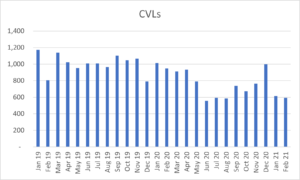
CVLs are the main way in which insolvent companies are brought to an end in the UK. You’ll see that typically prior to the March 2020 lockdown and start of government support to businesses, 1000 companies a month would go into CVL, but once the government support started to roll in, the average month (with the exception of December 2020 for some reason) stood at around 600. A 40 per cent fall, and in the midst of the pandemic!
Few industries can withstand a sustained 40% fall in sales volumes of their bread and butter work.
But is it just sales volumes that are falling?
I think not, I think the real picture for IPs is far, far worse. What I’m seeing is that a good proportion of the 600 companies going into CVL are small retail customer focused businesses, like shops, hairdressers, nail bars, takeaways, restaurants, which generally have few realisable assets of value. Put another way, there’s not a lot of assets / money around to pay a reasonable level of fees to the Insolvency Practitioner. So not only are sales volumes down, the average fee per assignment is also down. Double bubble! I get the impression some IPs will be needing an insolvency process themselves before too long if this carries on, unless they can do something about their high city centre overheads and salary bills.
The government are already pushing far forward their support to UK businesses, they obviously do not expect a quick solution to this pandemic. They have extended that help several times, to buy time for businesses. They’ve done it before, they will do it again. That’s what government do, buy time.
Here are the questions I have:
- When will the expected Tsunami of insolvencies arrive? There will be more false dawns.
- When it does arrive, as it surely must, how much of that will be low cost ‘burial work’, carried out for no profit; how much will be better quality work where the IP can provide a valuable outcome, like saving a business and at the same time earn a decent fee?
- How many firms of IPs will we see merge with or taken over by others in the meantime? How many IPs will simply retire, to avoid the Tsunami? How many will go into administration themselves, having run out of cash?
If I knew, I’d tell you…
Watch this space.