

There’s a long-standing frustration shared by many insolvency practitioners (IPs) — one that I’ve seen play out over and over again during my four decades in the profession. Company directors often delay seeking help until it’s too late. That delay costs jobs, destroys value, and leads to worse outcomes for everyone: staff, suppliers, customers, banks, HMRC, and even the directors themselves.
We’ve all heard it:
“I’m too busy right now.”
Often, that’s the excuse given when a director is locked in the daily fight for survival. They’re managing cash, placating creditors, juggling payroll, and firefighting on all fronts. Reaching out to an IP feels like admitting defeat — or worse, inviting a bureaucrat into a battlefield with clipboards and procedure manuals instead of solutions.
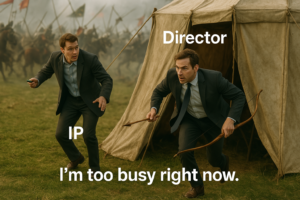
The image above is a humorous but painfully accurate reflection of how many IPs view this situation. The director, armed with a bow and arrow, dashes out of the tent into chaos. The IP, holding a submachine gun, is left behind, frustrated. It’s meant to say: Why wouldn’t you bring someone to the battle who actually has better tools?
But let’s dig deeper. The truth is more nuanced, and the blame isn’t one-sided.
The IP’s Perspective: Better Late Than Never (But Preferably Not Late)
From the insolvency practitioner’s point of view, early intervention is nearly always better. With more time, we can:
- Explore restructuring options
- Negotiate with stakeholders
- Preserve key staff and supplier relationships
- Protect brand value
- Maximise realisations for creditors
- Even, in some cases, save the business entirely
But these opportunities shrink as time goes on. By the time a director finally picks up the phone, the money may be gone, staff demoralised, creditors angry, the order book dissipated, and the viable parts of the business hollowed out.
That’s why many IPs feel like they’re called in not as surgeons, but as coroners.
But here’s the rub: many directors don’t believe we have anything better than they do.
The Director’s Perspective: Why Should I Call an IP?
Let’s now flip the image. Picture the same battlefield. The IP now holds a peashooter. The director thinks, Why would I waste time bringing this person in? They have no better ideas than I do.
And often, that perception isn’t wrong.
Most IPs aren’t trained in turnaround strategy. They’re compliance experts, not commercial innovators. They understand insolvency law and process, not business model redesign. Many haven’t run a business themselves. They’re not best trained to deal with people under stress, or to give directors the confidence and clarity they so desperately need.
Worse still, many IP firms haven’t invested in the tools required for modern support:
- No use of AI or automation to analyse data fast
- No rapid forecasting systems
- Poor communication methods
- Inflexible processes and outdated templates
And let’s be honest: too many IPs hide behind process instead of offering practical support. There are exceptions, of course. Some firms have invested in digital systems, cash flow modelling tools, even behavioural finance training. But the profession as a whole is lagging.
When All You Have Is a Hammer…
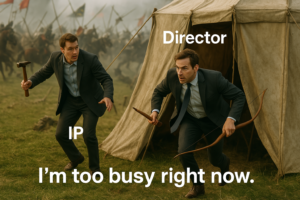
Then there’s the third image. This time, the IP has a hammer.
“If all you have is a hammer, everything looks like a nail.”
And if that nail is a Creditors’ Voluntary Liquidation (CVL)?
Here’s where things get uncomfortable. Many firms employ salespeople, directly or indirectly, whose job is to find directors in distress and get them into a CVL process. These people aren’t IPs. They may not fully understand the nuances of restructuring, nor have the duty to explore all the options. They’re often paid bonuses for getting CVLs over the line.
The result? Directors are sold a liquidation when other tools might have worked better. Administration, a Company Voluntary Arrangement (CVA), informal restructuring — or even non-insolvency solutions like refinancing or sale of part of the business.
This isn’t a small-firm problem. Some of the biggest firms in the UK run on this model. And directors are right to be wary. If you’re holding a hammer, a screw will be hammered anyway.
So Why Has Nothing Changed?
If this has been going on for decades — and it has — then the problem is systemic. There is a deep disconnect between the insolvency profession and the business community.
Directors don’t see IPs as allies. IPs are frustrated that directors show up only after the damage is done.
The result is pain that ripples far and wide:
- Employees lose their livelihoods
- Creditors lose money
- Shareholders are wiped out
- HMRC loses tax
- Banks suffer write-offs
- Directors may face personal liability
And yet we keep playing out the same tragic drama.
What Needs to Change?
Here’s where we need to be bold. If we keep doing what we’ve always done, we’ll keep getting what we’ve always got.
- Training and Mindset Shift for IPs
IPs must broaden their skill set. We need to think more like turnaround consultants, not just process managers. That means:
- Training in crisis communication
- Commercial awareness
- Negotiation skills
- Cash management
- Leadership under stress
- Emotional intelligence
- Tool Up: Embrace Technology
The tools many IPs use are years behind the curve. We need:
- Real-time financial dashboards
- AI-based scenario planning
- Automation of repetitive tasks
- Better communication platforms
This is not a luxury — it’s essential to stay relevant.
- Reform the Way Work Is Won
Regulators need to look at how work is marketed and sold. Commission-driven sales targeting vulnerable directors should be banned or strictly regulated. Only trained, authorised people should be allowed to advise directors on insolvency options.
- Early Warning Systems
Could HMRC or Companies House flag early signs of distress and trigger a ‘cooling off’ period where directors are encouraged (or even required) to speak to a qualified, independent restructuring advisor?
- Create a Middle Ground Profession
Do we need a new type of advisor? Someone who bridges the gap between turnaround specialist and IP — with a duty to explore all options, not just insolvency?
- Shift in Director Mindset
Directors need to stop seeing insolvency advice as an admission of failure. Instead, it should be seen as strategic decision-making. That requires education, cultural change, and perhaps most importantly, positive stories of survival.
Final Thoughts
In July 2025, I’ll mark 40 years in this profession. And in all that time, the gap between IPs and directors has barely narrowed. That’s not good enough.
The problem is deep, systemic, and affects thousands of people every year. But the solution — if there is one — requires a total rethinking of how we engage, advise, train, regulate, and present ourselves.
It’s time to stop blaming each other. It’s time to look at what’s broken and have the courage to fix it. Not next year. Now.
Because we’re all too busy to wait any longer.