
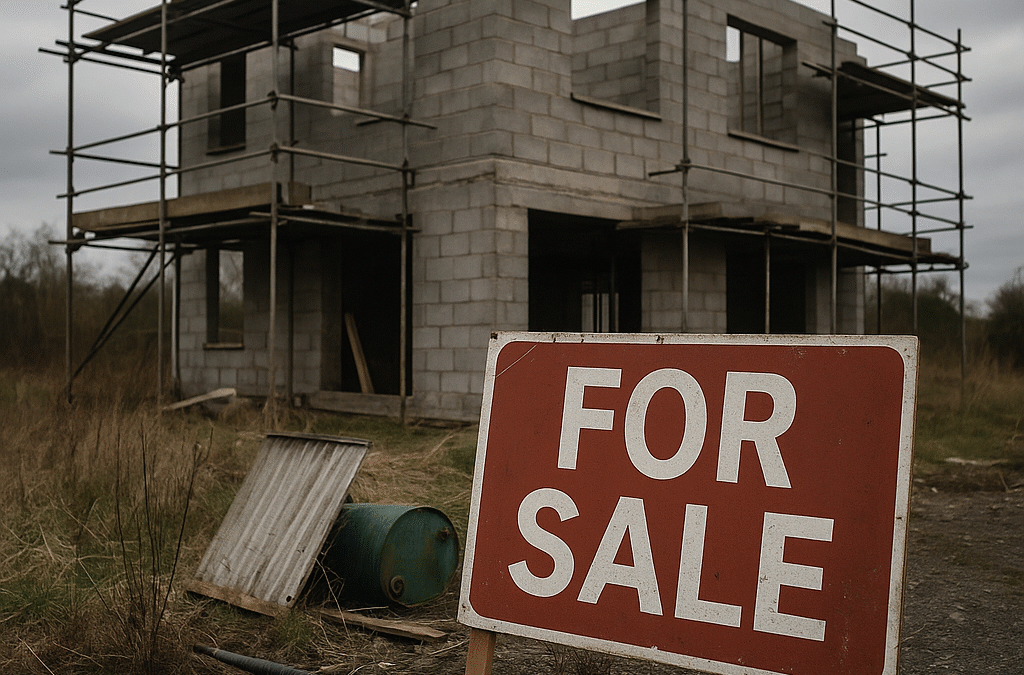
Even in Good Times, the Sector Struggles to Create Saleable Value — And in Bad Times, the Fallout Can Be Devastating
The UK construction sector is full of hardworking people delivering vital work. It contributes around 6% of UK GDP, employs over two million people, and quite literally builds the world around us.
And yet, in 2025, construction is a sector where businesses rarely sell, where founders rarely cash out, and where insolvency is both common and brutal.
Even in the good years, construction companies have struggled to realise meaningful value on exit. And when the downturn comes, things get worse fast.
So let’s ask the question no one wants to answer:
Why doesn’t anyone want to buy a construction company?
❌ 1. Good Companies Still Struggle to Sell
In most sectors, a profitable, well-run company can expect a decent multiple of profit on sale: perhaps 5–8× earnings or more.
But in construction?
You’ll be lucky to get 2× – and many companies don’t sell at all.
Buyers walk away. Founders retire and wind down. And in many cases, the company fails before a deal is ever done.
Even well-established firms with decent reputations can’t attract strategic buyers or private equity. Why?
Because construction has systemic problems.
🧱 2. Built on Fragile Foundations
Even in strong trading years, construction operates on a knife-edge:
-
Low margins (1–3% is typical)
-
Fixed-price contracts in an unstable economy
-
Long payment cycles and poor cash flow visibility
-
Reliance on subcontractors with unknown financial resilience
Every project is a potential profit centre or time bomb. And buyers know it.
🧍 3. Owner-Reliant, Not Systems-Reliant
Most construction firms are built around the founder:
-
The owner prices the jobs.
-
The owner knows the clients.
-
The owner smooths over disputes and finds the right subcontractors.
So when the owner wants to step away, the whole structure wobbles. Buyers don’t want to inherit that level of risk.
They want systems, pipeline, and management depth.
Too often, they find a spreadsheet and a mobile phone full of contacts.
📉 4. No Strategic Edge
High-multiple acquisitions are driven by strategic value – tech IP, protected supply chains, subscription income.
But construction companies usually have:
-
No intellectual property
-
No exclusive rights
-
No long-term recurring income
-
And nothing to prevent a client switching contractors next week
There’s nothing to anchor enterprise value.
Even good firms look like risky trades to outside investors.
💥 5. And When It Goes Wrong… It Goes Very Wrong
When a construction company fails, the damage can be extreme, and wildly worse than directors expect.
Here’s what we see, time and again, in formal insolvency appointments:
🧾 Debtor write-offs and contract chaos
Contract balances that looked promising on paper often collapse under scrutiny. Clients dispute claims, delay valuations, or bring in replacements. Retentions evaporate. Work in progress becomes a write-off.
The result? A massive drop in expected realisations, sometimes down to zero.
💳 Liabilities spiral
Directors are often shocked at how quickly the numbers worsen:
-
Unpaid subcontractors
-
CIS liabilities
-
VAT and PAYE arrears
-
Contract penalties and disputes
-
Material supplier debts
Insolvency crystallises these. Suddenly, a business that felt ‘tight but recoverable’ is millions underwater.
🧍♂️ Personal guarantees kick in
With such weak recoveries and high liabilities, lenders and suppliers go looking for someone to pay – and that often means the director’s PGs.
Whether it’s an asset-backed overdraft or a builders’ merchant account, PG calls are common and aggressive.
🛠 You need expert help – and that’s not cheap
Recovering value in construction insolvencies is complex and contentious. It’s the realm of:
-
Quantity Surveyors
-
Forensic accountants
-
Contract specialists
-
Construction Litigation-skilled solicitors
All of this comes at a cost – and that cost eats into asset realisations, often leaving nothing for creditors and a bill for the director.
This is why construction insolvencies are some of the hardest and costliest to manage.
It’s not just failure – it’s a perfect storm.
✅ MVLs Are Better – But Still Need Caution
Even solvent exits (like Members’ Voluntary Liquidations) are tricky in construction:
-
Final accounts need careful verification.
-
Contract balances must be reviewed in detail.
-
Debtor recoverability is never a given.
-
Retentions and disputed balances can’t simply be declared as assets.
-
Unwinding CIS or VAT overpayments may take time – and expertise.
If you get it wrong, the distribution could be overstated and the liquidator may have to chase directors for repayment.
An MVL in construction is not a box-ticking exercise. It’s a project that needs professional care.
🧮 6. The Numbers Just Don’t Work for Buyers
All of this makes construction companies poor acquisition targets unless they have something exceptional:
-
Framework contracts with blue-chip clients
-
Niche specialism in regulated sectors (MOD, rail, heritage)
-
Non-owner-reliant management teams
-
Recurring or retainer-based income
-
Clean, well-managed financials with strong margins
But those firms are rare- and buyers know it.
🚪 7. So What’s your Exit Plan?
If you’re a construction director, you need to think seriously about your endgame:
-
Will your business sell?
-
If not, are you planning to run it until you drop?
-
Do you know what will happen to your personal assets if things go wrong?
-
Is now the time to formalise your systems, review your pipeline, and protect your position?
In construction, hope is not a strategy.
🛠 Final Word
The UK construction sector is in a fragile state. Even the best-run companies face:
-
High risk
-
Low valuations
-
Poor buyer appetite
-
And severe consequences if things go wrong
If you’re building a business in this space, build with purpose:
-
Build to sell, if you can.
-
Build for income, if that’s your reality.
-
Or build a legacy that’s worth winding down carefully – not one that collapses in court and contract disputes.
Because no one else is going to make the hard decisions for you.