
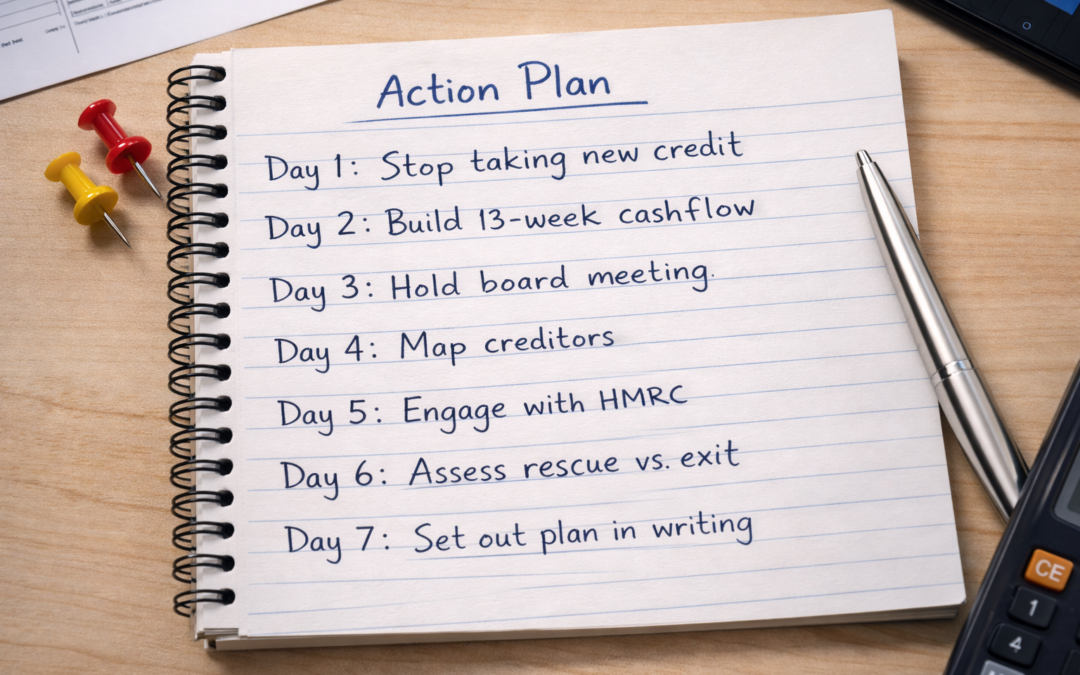
A practical action plan for directors who want to stay in control, protect creditors, and protect themselves
That moment arrives quietly for most directors.
You’re not sleeping well. You’re juggling payments. HMRC is chasing. Suppliers want pro-formas. Cash is leaving faster than it arrives.
If you’ve reached the point where you’re thinking, “We might be insolvent” … the next seven days matter.
Not because you need to panic. Quite the opposite.
Because the law expects you to act sensibly once insolvency is likely, and early, well-documented steps can protect creditors and significantly reduce personal risk.
This post is a practical follow-up to the directors’ duties blog of a few weeks ago. It is not about theory. It’s about what to do now.
Useful starting points:
-
Director responsibilities (gov.uk): https://www.gov.uk/guidance/being-a-company-director
-
Insolvency Service guidance: https://www.gov.uk/government/organisations/insolvency-service
-
Companies House search: https://find-and-update.company-information.service.gov.uk/
Day 1: Stop digging and stabilise
Your aim on day 1 is to stop making the position worse.
Stop doing this today
-
Do not take new credit (stock, services, etc) unless you are confident it can be paid when due.
-
Do not repay directors’ loans or pay connected parties ahead of others.
-
Do not move assets out of the company or sell cheaply to “friendly” buyers.
-
Do not pay only the loudest creditor unless there is a clear, documented reason that benefits creditors overall.
-
Do not ignore HMRC letters or miss filing deadlines to “buy time”.
Instead, do this:
-
Protect cash.
-
Pause discretionary spending.
-
Secure stock and assets.
-
Tell directors and senior staff the business is in a “controlled response period” for one week.
Day 2: Build a 13-week cashflow (the real one, not the hopeful one)
A 13-week cashflow forecast is the single most useful tool in early insolvency decision-making.
It shows whether:
-
there is a viable route through, or
-
you are simply delaying the inevitable and increasing creditor losses.
13-week cashflow checklist
Include these lines as a minimum:
Cash in
-
Opening bank balance
-
Sales receipts (by week, not by month)
-
Debtor collections (realistic, not aspirational)
-
VAT refunds or grants (only if confirmed)
-
Asset sale proceeds (only if achievable and timed)
Cash out
-
Net wages and key payroll dates
-
Rent and rates
-
Utilities
-
Insurance
-
HP/lease payments
-
Critical suppliers (keep trading only)
-
HMRC (VAT, PAYE, Corporation Tax as relevant)
-
Loan and overdraft servicing
-
Professional fees (budget honestly)
Controls
-
Mark each item as: “Committed”, “Likely”, or “Uncertain”
-
Update weekly, same day each week
-
Note assumptions in plain English
HMRC Time to Pay is not guaranteed, but if you are engaging with HMRC, your cashflow will need to support the proposal: https://www.gov.uk/guidance/time-to-pay-arrangements
Day 3: Hold a proper board meeting and minute it
If insolvency is likely, your decisions need a paper trail. Not fancy. Just clear.
This is one of the most common weaknesses I see later: directors did think about creditors, but they never recorded it.
Board minute template (copy and paste)
Company: [Company name]
Date/Time: [dd/mm/yyyy, time]
Attendees: [Names]
Chair: [Name]
1. Financial position
-
Current bank balance: £[ ]
-
Key arrears: HMRC £[ ], rent £[ ], trade creditors £[ ]
-
Summary of cashflow forecast: [e.g., projected cash shortfall in week 4]
2. Insolvency assessment
-
Cashflow insolvency indicators: [list]
-
Balance sheet position (if known): [brief note]
-
Directors consider insolvency is [possible/likely] within [timeframe].
3. Creditor interests
Directors note that where insolvency is likely, decisions must prioritise creditors’ interests.
4. Immediate actions agreed
-
13-week cashflow to be completed/updated by [name] by [date]
-
Freeze non-essential spending with immediate effect
-
Asset register to be prepared and secured
-
HMRC engagement plan to be prepared
-
Advice to be taken from licensed insolvency practitioner
5. Trading decision
Directors decide to [continue trading on limited basis / cease trading / review again in 48 hours] because:
-
[reasons linked to minimising creditor losses]
6. Next meeting
Scheduled for [date/time].
Signed: ___________________ Date: __________
Day 4: Map your creditors and stop “random payments”
By day 4 you should know:
-
who you owe
-
how much
-
what is overdue
-
what is essential to keep trading safely
Create a simple list with:
-
creditor name
-
amount
-
due date
-
status (current/overdue/disputed)
-
enforcement risk (high/medium/low)
Day 5: Engage HMRC early and factually
HMRC is not persuaded by emotion. They respond to:
-
filings being up to date
-
a credible plan
-
evidence-backed numbers
Start here: https://www.gov.uk/topic/business-tax/insolvency
If Time to Pay is appropriate, understand the principles: https://www.gov.uk/guidance/time-to-pay-arrangements
Keep communications factual and consistent with your cashflow.
Day 6: Decide if rescue is realistic … or if you need a controlled exit
By day 6 you should be able to answer:
-
Is there a viable core business?
-
Do we have enough cash control to trade safely?
-
Would continuing to trade increase creditor losses?
-
Is a rescue tool (CVA, administration) realistic?
-
Is an orderly closure (CVL) now the best way to protect creditors and reduce risk?
If you’re not sure, this is exactly when directors should take advice. Early advice usually expands options, it doesn’t shut them down.
Day 7: Put your plan in writing and communicate it properly
Directors should not drift.
By day 7, set out one page:
-
current position
-
chosen route (rescue, restructure, controlled wind-down)
-
next steps and dates
-
who is responsible for what
If trading continues, make sure it is on a disciplined basis with updated forecasts and properly recorded decisions.
Takeaway checklist: The first 7 days
-
Stop taking new credit you cannot realistically pay
-
Build and update a 13-week cashflow
-
Hold a board meeting and minute decisions
-
Create a creditor schedule and avoid random payments
-
Engage HMRC early with evidence-backed numbers
-
Decide whether rescue is viable or exit is needed
-
Write down the plan and stick to it
Final thought
The directors who come through this best are rarely the ones with perfect trading conditions. They are the ones who act early, keep records, and treat creditors fairly once insolvency is likely.
If you’ve reached that moment of realisation, the next week is about calm control … not panic. Perhaps call me on 07813102014?
Hashtags
#Insolvency #Directors’Duties #CompanyInDifficulty #Cashflow #HMRC #UKInsolvency