
There’s a moment most directors recognise… usually late at night, staring at online banking, refreshing the screen as if the numbers might magically improve.
Sales are uneven. Creditors are calling more often. VAT is looming. Payroll is getting uncomfortably close.
And the question quietly forms:
‘Do we actually have enough cash to get through the next few months?’
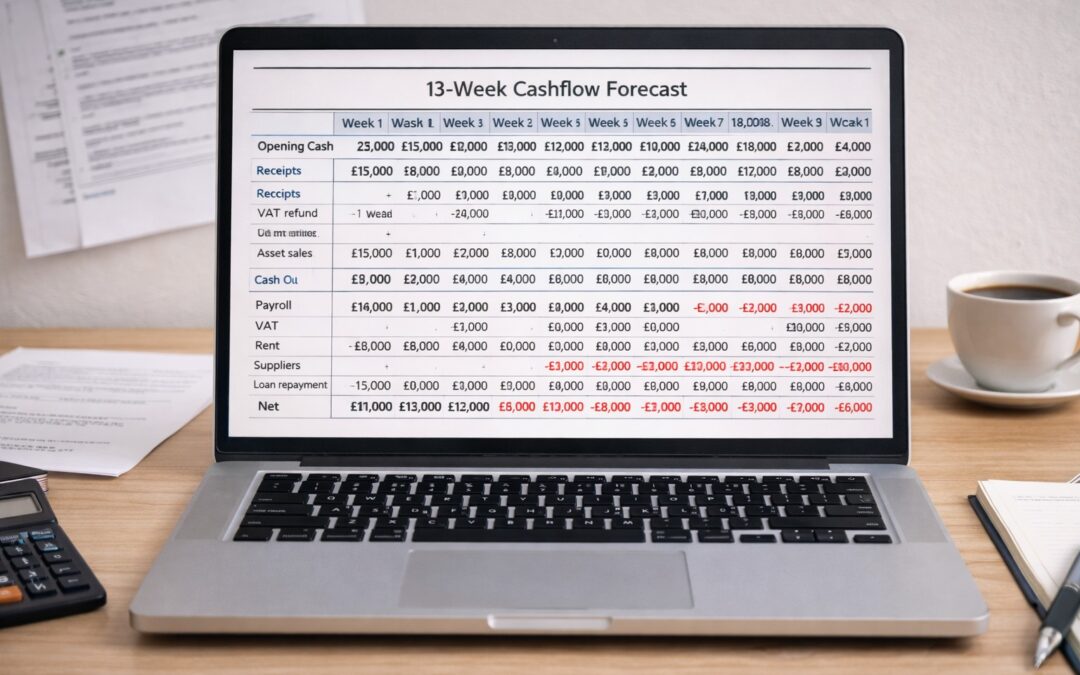
That’s where a 13‑week cashflow forecast comes in. Not as an accounting exercise. Not as paperwork for lenders. But as one of the most practical survival tools a director can have when financial pressure starts building.
I’ve seen businesses rescued because someone built one early. And I’ve seen others fail simply because nobody truly understood the timing of cash.
Let’s walk through it properly…
Why 13 weeks?
Three months is long enough to see problems coming… but short enough to be realistic.
Annual forecasts are often optimistic. Monthly figures can hide trouble. A weekly forecast forces honesty.
It answers three critical questions:
-
When will cash run out?
-
Which payments genuinely matter most?
-
Is rescue realistic or are losses increasing?
Once insolvency becomes a possibility, directors must consider creditor interests carefully. Guidance from the Insolvency Service explains directors’ responsibilities here:
https://www.gov.uk/government/organisations/insolvency-service
A reliable cashflow forecast shows you’re acting responsibly and making informed decisions.
What a 13‑week forecast actually looks like
Forget complex spreadsheets for a moment.
At its heart, it’s simply:
Opening cash + money coming in – money going out = closing cash each week
That’s it.
But the detail matters enormously.
You’re tracking real cash movement, not profit.
So include:
Cash in
-
Customer receipts (based on realistic payment behaviour)
-
Existing contracts already agreed
-
VAT and other refunds due
-
Asset sales already planned
Cash out
-
Wages and PAYE
-
Rent and utilities
-
Supplier payments
-
Loan repayments
-
VAT, PAYE and Corporation Tax liabilities
Notice what’s missing? Hope. Guesswork. ‘Expected big deals’.
If it isn’t contracted or highly likely, leave it out.
The most common mistake directors make
Optimism bias.
I understand it because after all you built the business and believe in it. And you have solved problems before.
But creditors and courts look at realism, not belief.
If customers normally pay in 45 days, forecasting payment in 14 won’t help anyone. Least of all you.
Cases on director conduct examined through BAILII often hinge on whether decisions were reasonable at the time: https://www.bailii.org/
A sensible forecast demonstrates judgement. An unrealistic one can suggest avoidance.
Why HMRC cares about your forecast
HMRC is frequently the largest creditor when businesses struggle.
The good news? They’re often pragmatic when approached early.
The less good news? They expect evidence.
A credible forecast supports Time to Pay discussions: https://www.gov.uk/difficulties-paying-hmrc
Without one, negotiations become difficult because HMRC can’t see how you’ll meet future obligations.
Think of it from their perspective… they’re being asked to wait. They need confidence there’s a plan.
What the forecast tells you
Directors often tell me the same thing after completing their first proper forecast:
‘I finally slept.’
Not because the numbers were good, bercause often they weren’t.
But uncertainty is exhausting. Clarity, even if uncomfortable, gives control back.
The forecast usually reveals one of three realities:
-
Short-term pressure but survivable
Cost reductions or creditor arrangements may stabilise things. -
Funding gap requiring action
Refinancing, restructuring, or formal procedures might help. -
Cash exhaustion approaching quickly
At this stage, protecting creditors becomes critical.
Practical tips from experience
After decades working with directors, a few habits consistently make forecasts useful rather than theoretical:
-
Update weekly, not monthly
-
Use conservative income assumptions
-
Separate essential and non‑essential payments
-
Identify ‘trigger points’ where decisions must change
-
Share the forecast with advisers early
-
Record board discussions linked to forecast results
And one slightly uncomfortable truth…
If you’re avoiding building a forecast because you fear what it might show, that’s usually the strongest sign you need one.
Takeaway Checklist
If your company is under financial pressure, start here:
-
Prepare a rolling 13‑week cashflow forecast
-
Base receipts on actual payment history
-
Include all tax liabilities owed to HMRC
-
Update figures weekly
-
Identify when cash dips below safe levels
-
Document board decisions linked to forecasts
-
Engage HMRC early if payments may be missed
-
Seek professional advice before cash runs out
-
Keep Companies House filings up to date
-
Review director duties via Insolvency Service guidance
Final thought
Insolvency rarely arrives as a sudden event. It creeps in quietly through missed forecasts, delayed decisions, and unclear numbers.
A 13‑week cashflow forecast shines a light exactly where directors most need it.
It doesn’t solve problems by itself. But it tells you which problems can be solved… and which need decisive action now rather than later.
And in my experience, directors who face the numbers early almost always have more options than those who don’t.