
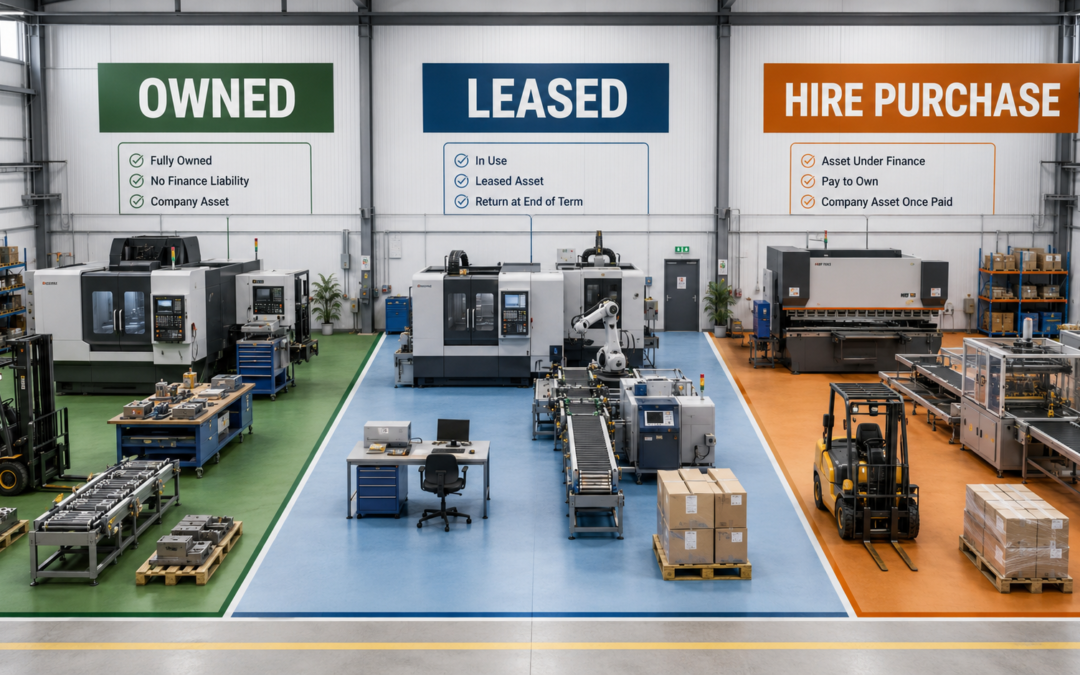
A company’s asset register can be misleading.
It may list vans, forklifts, machinery, photocopiers, computers and specialist equipment. But that doesn’t necessarily mean the company owns them.
Some may be leased. Some may be hired. Some may be subject to hire purchase or conditional sale. Others may have been bought using asset finance secured against the equipment itself.
When insolvency becomes possible, directors need to understand the difference quickly. Selling, hiding or continuing to use someone else’s property without authority can create a far bigger problem than the original arrears.
Start with the basic question… who owns the asset?
Possession is not ownership.
A machine may have been on the factory floor for six years and appear in the company’s accounts, but legal ownership may still sit with a finance company.
HMRC’s leasing guidance describes a lease as an arrangement under which one party hires an asset to another in return for rental payments. A finance lease may look economically similar to borrowing money to buy an asset, but the legal ownership position still depends on the agreement.
Therefoe directors should identify whether each asset is:
- owned outright;
- rented or hired;
- held under an operating lease;
- held under a finance lease;
- subject to hire purchase;
- subject to conditional sale;
- charged to a lender;
- owned by a director, employee or another group company.
Don’t rely solely on the fixed asset register. Find the contract.
Hire purchase and conditional sale
Under hire purchase, the company normally pays instalments for possession and use of the asset, with ownership passing only after all the contractual conditions have been satisfied.
A conditional sale agreement is similar, although ownership may pass automatically once all required payments have been made.
The company may therefore have paid most of the price without yet owning the asset.
That does not mean the agreement has no value.
Hire purchase and conditional sale arrangements can contain equity for the insolvent estate where the asset’s value exceeds the finance settlement figure and sale costs.
For example:
- equipment value: £80,000;
- finance settlement: £45,000;
- realisation costs: £5,000.
There may be approximately £30,000 of equity.
Simply allowing the finance company to repossess the equipment without first checking the figures could lose value for creditors.
Operating leases and ordinary hire
An operating lease or hire agreement usually gives the company a right to possess and use the asset while payments and other contractual obligations are maintained. However ownership remains with the lessor.
This means that the insolvent company’s rights will generally be limited to possession and use while payments are up to date. And the agreement will often allow termination following payment default or insolvency.
Common examples include:
- photocopiers;
- forklifts;
- vehicles;
- plant and machinery;
- telephone systems;
- office equipment;
- temporary buildings;
- storage containers.
These assets should not normally be included in the company’s assets as though they were owned outright.
What happens when insolvency starts?
The answer depends partly on the procedure.
Liquidation
In liquidation, the liquidator will usually decide whether there is any benefit in retaining or acquiring an asset.
Where the company has no ownership or equity, the owner will normally seek its return.
Where there is equity, the liquidator may explore:
- settling the finance;
- agreeing a sale with the owner;
- selling the company’s interest;
- transferring the agreement to a buyer;
- continuing payments temporarily where that benefits creditors.
The liquidator must first understand the agreement and the commercial value.
Administration
Administration is different because there may be an attempt to rescue the business or sell it as a going concern.
The administrator may need leased or financed assets to keep trading.
The statutory administration moratorium restricts certain enforcement action. Goods subject to hire purchase cannot simply be repossessed during administration without the administrator’s consent or the court’s permission. The statutory definition for these purposes includes conditional sale and chattel leasing agreements.
That can give the administrator breathing space.
It doesn’t give the company free use of the asset forever. Payments, insurance, maintenance and negotiations with the owner still need to be addressed.
Can the agreement be transferred to a buyer?
Possibly, but not automatically.
A purchaser of the business may want the company’s:
- vehicle fleet;
- manufacturing equipment;
- telephone system;
- forklifts;
- software licences;
- rented premises.
The buyer cannot simply take over because it has bought the business assets.
The owner or finance company may require:
- a fresh credit application;
- payment of arrears;
- revised terms;
- a deposit;
- formal assignment or novation;
- return of the equipment and entry into a new agreement.
Early contact matters.
A proposed sale can collapse if everyone assumes that essential leased machinery will transfer and the finance company says no at the last moment.
Don’t forget software and digital equipment
Not every hired asset is made of metal.
A company may depend on:
- cloud software;
- design licences;
- accounting subscriptions;
- telephone platforms;
- server hosting;
- leased printers;
- data storage;
- specialist control software attached to machinery.
The Corporate Insolvency and Governance Act 2020 introduced restrictions on certain suppliers terminating contracts solely because a company enters a relevant insolvency procedure. The legislation was intended to help preserve supplies while a rescue or sale is considered.
However, there are exceptions and the company may still have to pay for continued supply.
Directors should not assume that every software licence can be transferred to a buyer.
What directors should do before insolvency
Prepare a complete financed-assets schedule showing:
- asset description;
- serial number;
- location;
- legal owner;
- type of agreement;
- agreement number;
- monthly payment;
- arrears;
- settlement figure;
- estimated market value;
- expiry date;
- purchase option;
- termination rights;
- whether the asset is essential to trading;
- whether the agreement can be transferred.
Photograph the assets and keep copies of every agreement.
Finance companies should be listed separately from ordinary trade suppliers.
What directors must not do
Directors should not:
- sell leased assets as though the company owns them;
- move equipment to another site to prevent repossession;
- remove serial plates or ownership labels;
- transfer assets to a connected company;
- promise equipment to a buyer without checking title;
- stop insurance cover without considering the owner’s rights;
- surrender valuable equipment without checking whether equity exists;
- pay one finance company simply because the director has personally guaranteed it.
Those decisions can affect creditors and may later be investigated.
When should payments continue?
Not every lease or finance payment should automatically stop.
Payment may be justified where the asset is necessary to:
- finish profitable work;
- preserve stock;
- maintain safety;
- collect book debts;
- complete an orderly closure;
- support a going-concern sale;
- prevent the loss of substantial equity.
The decision should be based on the ultimate creditor benefit, not habit or pressure.
Record why the payment is necessary.
Takeaway checklist
- Do we know which assets the company actually owns?
- Have all hire, lease and finance agreements been located?
- Are serial numbers and asset locations recorded?
- What arrears exist?
- What are the current settlement figures?
- Does any agreement contain equity?
- Which assets are essential to continued trading?
- Can the agreements be assigned or transferred?
- Has the owner consented to any proposed business sale?
- Are insurance and maintenance obligations being met?
- Have directors avoided selling or moving third-party assets?
- Has advice been taken before surrendering valuable equipment?
Final thought
A company can look asset-rich while owning surprisingly little.
Equally, a financed asset that appears to belong to someone else may contain valuable equity for creditors.
The answer sits in the agreement, the settlement figure and the market value.
Don’t guess.
Before the company sells, returns or continues using any financed asset, establish exactly who owns it… and what the company’s interest is worth.
#AssetFinance #HirePurchase #LeasedAssets #CompanyInsolvency #DirectorsDuties #Administration #BusinessRescue