
For many directors, the first meeting with an insolvency practitioner feels like crossing a line.
It shouldn’t.
Coming to see me doesn’t mean you’ve decided to liquidate the company. Quite the opposite. The earlier we talk, the more likely it is that there are still choices.
The purpose of a good first meeting isn’t to sell you an insolvency procedure. It’s to understand what has happened, where the company stands today and what can realistically be done next.
Start with the business, not the insolvency
I want to understand the business before discussing procedures.
What does it do? How many people does it employ? Is the underlying business profitable? What has changed? Has a customer failed, margins collapsed, HMRC pressure increased, or has the company simply grown faster than its cash resources?
Sometimes the problem is temporary. Sometimes it isn’t.
That distinction matters.
How bad is the cash position?
Cash is usually where the conversation becomes real.
I want to know:
-
what’s in the bank today;
-
what has to be paid this week and this month;
-
wages and PAYE due;
-
rent and finance payments;
-
what customers genuinely owe;
-
what cash is actually expected in;
-
whether facilities are still available.
A 13-week cashflow is extremely useful, but don’t postpone the meeting if one hasn’t been prepared.
Bring what you’ve got.
Who is owed money?
We need a reasonably accurate creditor position.
HMRC often matters particularly, but so do landlords, secured lenders, finance companies, critical suppliers, employees and anyone threatening legal action.
Tell me about winding-up petitions, statutory demands, CCJs, enforcement agents and threats to withdraw essential supplies.
Don’t hold back any of the story from me. The awkward bits are often the most important bits I most need to know.
What does the company own?
I’ll look at the assets too… cash, debtors, stock, machinery, vehicles, property, intellectual property, websites, customer databases and anything else of value.
Ownership will need to be checked. A machine sitting on the factory floor might be owned outright, leased or subject to hire purchase. Stock may be subject to retention of title.
That can significantly change the picture.
What have the directors done recently?
This isn’t an interrogation, but if insolvency is approaching, recent transactions matter.
Have directors been repaid? Have assets been sold? Have some creditors been paid ahead of others? Have dividends been taken? Is there an overdrawn director’s loan account? Has anything moved to another company?
Tell me early. There may be a perfectly sensible explanation. Finding it out later is much worse.
Directors’ responsibilities also change as financial distress deepens. The Supreme Court confirmed in BTI 2014 LLC v Sequana SA [2022] UKSC 25 that, in certain circumstances, creditors’ interests become part of what directors must consider. It isn’t triggered merely because insolvency is a remote possibility, but it becomes increasingly important as the company’s financial position deteriorates. (Supreme Court UK)
Can the business be saved?
This should be a central part of the meeting.
Could costs be reduced? Could surplus assets be sold? Will the bank help? Could HMRC agree Time to Pay? Is refinancing realistic? Could shareholders introduce money? Could an unprofitable division or site be closed? Is there a viable core business worth preserving?
Formal insolvency may be necessary, but it shouldn’t be the starting assumption when talking to any IP.
Then, and only then, look at the formal options
Only once I understand the facts does it make sense to discuss CVA, administration, creditors’ voluntary liquidation or other formal processes.
And more often than not nowadays the answer is none of them.
A good IP should explain the advantages, disadvantages, likely costs, timescale and practical consequences of each and every realistic option… including what it means personally for the directors.
What should you bring to a meeting with me?
Ideally, bring the latest accounts and management figures, aged debtors and creditors, bank balances, HMRC position, cashflow forecast, asset list, finance agreements, leases, employee numbers, details of guarantees, director’s loan account and important legal correspondence.
But please don’t delay seeking advice if the paperwork isn’t perfect.
Takeaway checklist
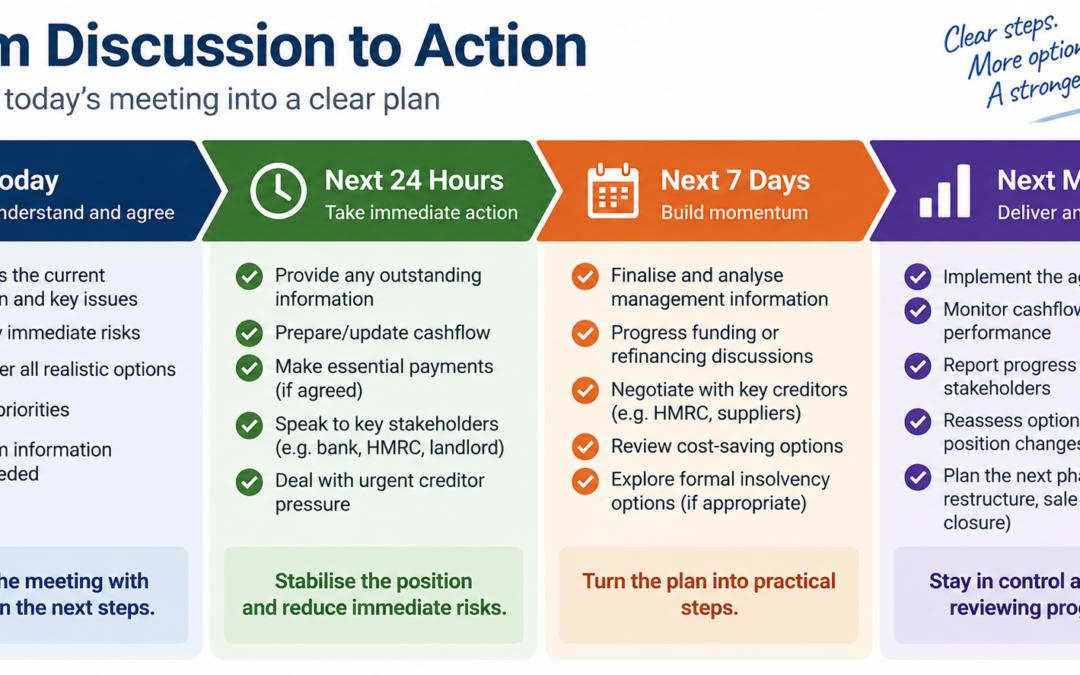
Before leaving the first meeting, you should understand whether the company is presently insolvent or close to it; whether it can continue paying debts as they fall due; whether the underlying business is viable; what immediate threats exist; what should and shouldn’t be paid now; what more information is needed; whether directors are personally exposed anywhere; whether rescue, refinance or a business sale is realistic; which formal insolvency options are genuinely relevant; and what needs doing in the next 24 hours, seven and 30 days.
Final thoughts
The best first insolvency meetings don’t end with a director being pushed towards a liquidation, they end with clarity.
You should leave understanding where your company and you stand, what your and the company’s realistic choices are and what needs to happen next. Sometimes that means saving the company, sometimes it means closing it properly. Either way, knowing sooner is usually better than knowing later.
Hashtags: #CompanyInsolvency #Directors #BusinessRescue #Turnaround #Cashflow #InsolvencyAdvice #BusinessRecovery
Our contact details: tel 01902 672323, email paul@midlandsbusinessrecovery.co.uk