
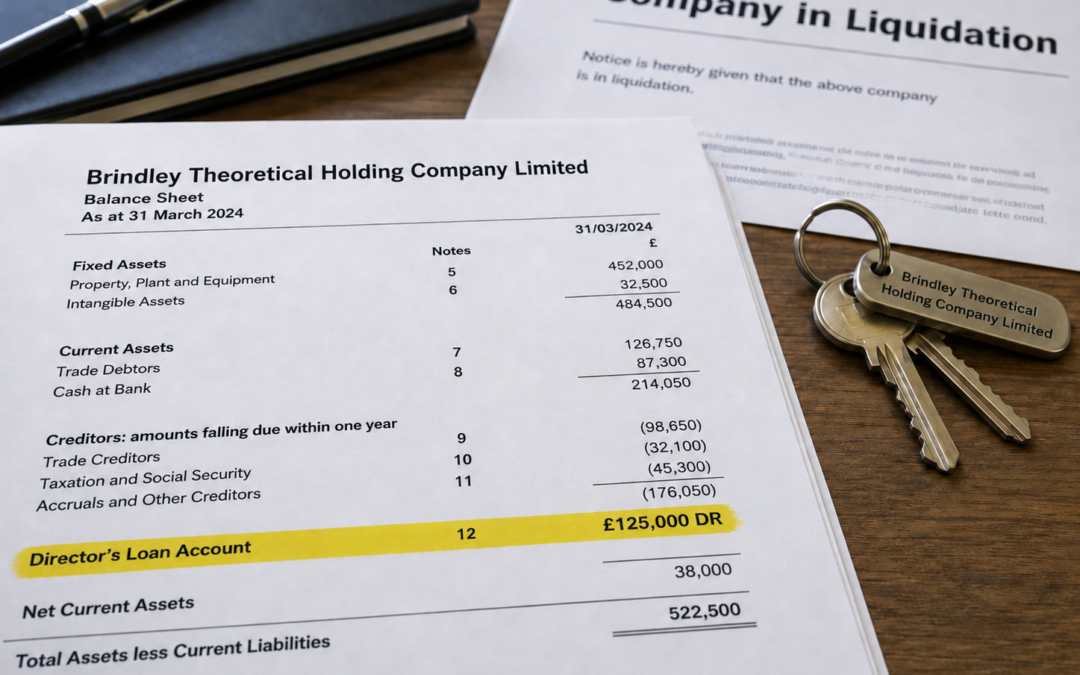
One of the more difficult conversations I have with directors concerns an overdrawn director’s loan account.
The director often regards it as an accounting entry. I, as liquidator, have to regard it as an asset.
If a director has taken money from the company which was not salary, a properly declared dividend, reimbursement of business expenses or repayment of money previously introduced, that money normally remains due to the company. Liquidation does not make the debt disappear. I like all liquidators may have to collect it, even where the director no longer has the money to repay it.
How common are overdrawn directors’ loan accounts?
There is no reliable published percentage covering every Creditors’ Voluntary Liquidation and Compulsory Liquidation. However, recent Insolvency Service research gives us a useful indication of how widespread the issue is.
A review of 2,309 solvent, Members’ Voluntary Liquidations, found overdrawn directors’ loan accounts in 541 cases. That is 23% of all the solvent liquidations examined.
The median overdrawn balance was approximately £100,885. Half of the balances fell between approximately £41,202 and £290,000, while the largest was £7.775 million.
That 23% figure should not be presented as the incidence across all liquidations. The research concerned solvent MVLs, where there will usually be sufficient assets to pay creditors and make a distribution to shareholders.
Nevertheless, it demonstrates that overdrawn loan accounts are not an occasional technical problem. They arise in nearly one in four of the solvent liquidations studied.
In an MVL, the loan can often be cleared by setting it against the director-shareholder’s eventual capital distribution. In an insolvent liquidation there is normally no shareholder distribution. The director therefore has to find the money personally.
That is where the real difficulty begins.
What exactly is a director’s loan account?
A director’s loan account records money moving between the company and a director.
It may be in credit because the director has lent money to the company. Alternatively, it may be overdrawn because the director has taken out more than they have introduced.
The Insolvency Service describes a director’s loan as company money taken by a director which is not salary, dividend, an expense repayment or the repayment of money previously paid into the company. The account should include cash withdrawals and personal expenditure paid using company funds.
The important point is that the money still belongs to the company. The overdrawn balance is a debt owed by the director.
How are overdrawn loan accounts actually created?
The Ross Martin guide which prompted this blog (thank you, it’s a superb guide) supplied with this article is useful because it shows that a director’s loan account is not always created by a clearly documented loan agreement.
In owner-managed companies, the balance often grows through a mixture of transactions:
- regular drawings taken instead of salary;
- personal bills paid from the company bank account;
- company credit cards used for private expenditure;
- tax, mortgage or household payments made on behalf of the director;
- dividends taken ‘on account’ before the company’s profits have been established;
- money moved between connected companies;
- expenses which cannot subsequently be supported;
- cash withdrawals which have not been properly explained.
The guide also explains that the tax definition of a loan is wider than an ordinary cash advance. A loan can arise where a person incurs a debt to the company, where a third-party debt is assigned to the company, or where funds are routed through another company, partnership or trust for the benefit of the director or shareholder.
It also warns that an unlawful dividend which is not repaid may be treated as a loan to the shareholder. Indirect arrangements can be caught even where the company has not transferred the money straight into the director’s personal bank account.
This matters because directors sometimes believe that the description entered into the bookkeeping system decides the legal position. It does not.
Calling a payment a dividend does not make it lawful. There must have been sufficient distributable reserves and a valid decision to declare the dividend. Retrospective paperwork cannot create profits which did not exist.
Similarly, calling personal expenditure a business expense does not prevent the liquidator from examining what the money was actually spent on.
The tax problems surrounding an overdrawn loan
An overdrawn DLA can produce tax liabilities long before a company reaches liquidation.
Where a close company makes a loan to a shareholder or other participator and it remains unpaid more than nine months after the end of the relevant accounting period, the company generally becomes liable to a tax charge under section 455 of the Corporation Tax Act 2010.
For loans made on or after 6 April 2026, the section 455 rate is 35.75%. Earlier advances remain subject to the rates applying when they were made.
The Ross Martin guide highlights several additional problems:
- A loan above the relevant threshold, particularly where little or no interest is paid, may create a taxable benefit in kind.
- Repaying a loan shortly before the tax deadline and withdrawing the money again shortly afterwards may be caught by the bed and breakfasting rules.
- There is a 30-day matching rule where repayments and further advances of £5,000 or more occur within the relevant period.
- A separate rule can apply to loan balances of £15,000 or more where arrangements existed to redraw the money, even outside the 30-day period.
- Indirect loans and arrangements conferring a benefit can fall within anti-avoidance legislation even where the transaction has a commercial purpose.
The section 455 payment does not repay the director’s debt. It is a company tax charge connected with the outstanding loan. The director still owes the full balance.
If the loan is later repaid, released or written off, the company may be able to recover the relevant section 455 tax. The repayment cannot normally be made until nine months and one day after the end of the accounting period in which the repayment, release or write-off occurred.
A write-off is not necessarily a tax-free escape for the director. The amount released or written off may be taxable as the director’s income and may also produce a Class 1 National Insurance liability.
What must the liquidator do?
The liquidator cannot simply accept the balance appearing in the last accounts, but neither can they ignore it.
The account has to be investigated, established and then dealt with commercially.
1. Establish the true balance
The liquidator must obtain and review:
- the nominal ledger and detailed director’s loan account;
- company bank and credit card statements;
- payroll records;
- dividend vouchers and board minutes;
- expense claims and supporting receipts;
- statutory accounts and management accounts;
- Corporation Tax returns, including CT600A disclosures;
- records of money introduced by the director;
- transactions involving connected companies or family members.
This exercise may increase or reduce the balance.
The director should receive credit for genuine money introduced, valid salary, legitimate business expenses and properly declared, legal, dividends. Conversely, unexplained withdrawals, private expenses and unsupported journal entries may need to be added back.
A signed set of accounts showing an overdrawn DLA is important evidence, particularly where the director approved those accounts. But the liquidator should still examine the underlying transactions rather than treating the accounts as infallible.
2. Apply insolvency set-off where appropriate
The director may also be owed money by the company. For example, the director may have introduced funds at a different time or have a valid claim for unpaid remuneration or expenses.
Where there are mutual debts or dealings falling within the insolvency set-off rules, the respective balances may be set against one another and only the net amount recoverable or provable.
That does not mean that every amount the director claims can automatically be deducted. The director still has to establish that the company genuinely owes it.
3. Make a formal demand
Once the balance has been established, the liquidator should demand repayment.
The director should be told clearly:
- how the balance has been calculated;
- why it remains due;
- when payment is required;
- what information is needed if the debt is disputed;
- the possible consequences of non-payment.
The Insolvency Service expressly warns that a liquidator may take legal action to collect the money and that a director who cannot repay may be placed at risk of bankruptcy.
4. Investigate the director’s means
A demand for £200,000 is of little value if the director has no assets and no income. Equally, a claim should not be abandoned simply because the director says they cannot afford to pay.
The liquidator may need evidence of:
- property ownership and available equity;
- savings and investments;
- employment or business income;
- interests in other companies;
- vehicles and other material assets;
- existing secured and unsecured liabilities;
- recent transfers of assets;
- the director’s spouse or family holding property which was previously owned by the director.
The purpose is not to punish the director. It is to decide what can realistically be recovered for creditors.
5. Decide whether settlement or proceedings produce the better result
A liquidator does not have to spend £50,000 recovering £30,000.
A properly negotiated settlement may be appropriate where there are genuine disputes, limited means, litigation risk or substantial enforcement costs. Instalments, security over property or a reduced lump-sum payment may produce a better result than lengthy proceedings followed by bankruptcy.
But any compromise must be supported by evidence and recorded properly.
The fact that the director selected the insolvency practitioner does not entitle the director to a favourable deal. The liquidator acts for the estate and the creditors, not for the person who made the appointment.
Simple debts can be pursued through ordinary collection procedures. Where liability is disputed or the case is complex, legal advice may be needed and proceedings should be considered if they are commercially worthwhile.
Where withdrawals involved misapplication of company money, breach of duty or improper retention of company property, the liquidator may also consider a misfeasance claim under section 212 of the Insolvency Act 1986. That provision can allow the court to order a director to repay, restore or account for company money or property, or contribute compensation.
6. Deal with the tax recovery
The liquidator should establish whether the company paid section 455 tax on the loan.
If the loan is repaid, released or written off, a claim for the appropriate tax repayment can be made. This can produce an additional recovery for the liquidation estate, but the timing rules and claim deadlines must be watched carefully.
If only part of the loan is repaid or released, only the corresponding part of the section 455 tax can normally be reclaimed. HMRC has also confirmed that there is no prescribed wording for writing off a DLA. The essential question is whether the company has accepted that the debt will not be paid and has given up attempts to collect it.
A liquidator should not write off a balance casually. The decision should follow a documented assessment of recoverability and the consequences for the estate.
What directors and accountants should do before liquidation
The worst time to investigate a director’s loan account is after the records have been abandoned and the company’s bank account is empty.
Before liquidation, the director and accountant should:
- reconcile the account down to individual transactions;
- identify private expenditure and unsupported withdrawals;
- confirm which dividends were lawfully declared;
- calculate any section 455 liability;
- stop further drawings;
- consider whether repayment can be made;
- avoid transferring assets or manufacturing retrospective paperwork;
- tell the proposed liquidator the full position.
An overdrawn DLA should never be hidden in ‘other debtors’ or left unexplained in a balance sheet. Nor indeed in one case I saw recentlky where a £400k overdrawn DLA was netted off creditors!!!!
The director may have spent the money years ago. That does not alter the fact that it remains company money.
The final point
An overdrawn director’s loan account is frequently one of the largest assets in an insolvent owner-managed company.
For the director, it can mean a substantial personal liability at precisely the point when their income has disappeared and their business has failed.
For the liquidator, it is not optional paperwork. The balance must be investigated, quantified and pursued where there is a reasonable prospect of recovery. Any settlement or write-off must be capable of being justified to creditors.
The earlier the position is identified, the more options there usually are. Leaving it until liquidation rarely makes it easier.
This article provides general information only. The legal and tax treatment depends on the facts of the individual case and professional advice should be obtained.
#DirectorsLoanAccount #DLA #OverdrawnDirectorsLoan #CompanyInsolvency #Liquidation #CreditorsVoluntaryLiquidation #CVL #Insolvency #InsolvencyPractitioner #Section455 #HMRC #OwnerManagedBusiness #SMEBusiness #Accountants #BusinessAdvisers