
A director asks me:
“The company owes HMRC VAT and PAYE. If it goes into liquidation, can HMRC come after me personally?”
Usually, these are company debts. Limited liability doesn’t disappear because HMRC is the creditor.
But there are exceptions, and two types of notice are worth understanding. They are not interchangeable.
Ordinary arrears don’t automatically create personal liability
A company can fall behind with VAT, PAYE and National Insurance because customers pay late, margins collapse or a rescue fails.
That may leave a substantial claim in liquidation. It does not automatically make the director personally liable.
What concerns me – and indeed HMRC and the Insolvency Service – is when directors treat HMRC as an unlimited source of working capital, build arrears without a credible plan, or repeatedly leave tax debts behind in failed companies.
The law distinguishes genuine failure from particular conduct that justifies personal recovery.
Personal Liability Notices: unpaid National Insurance
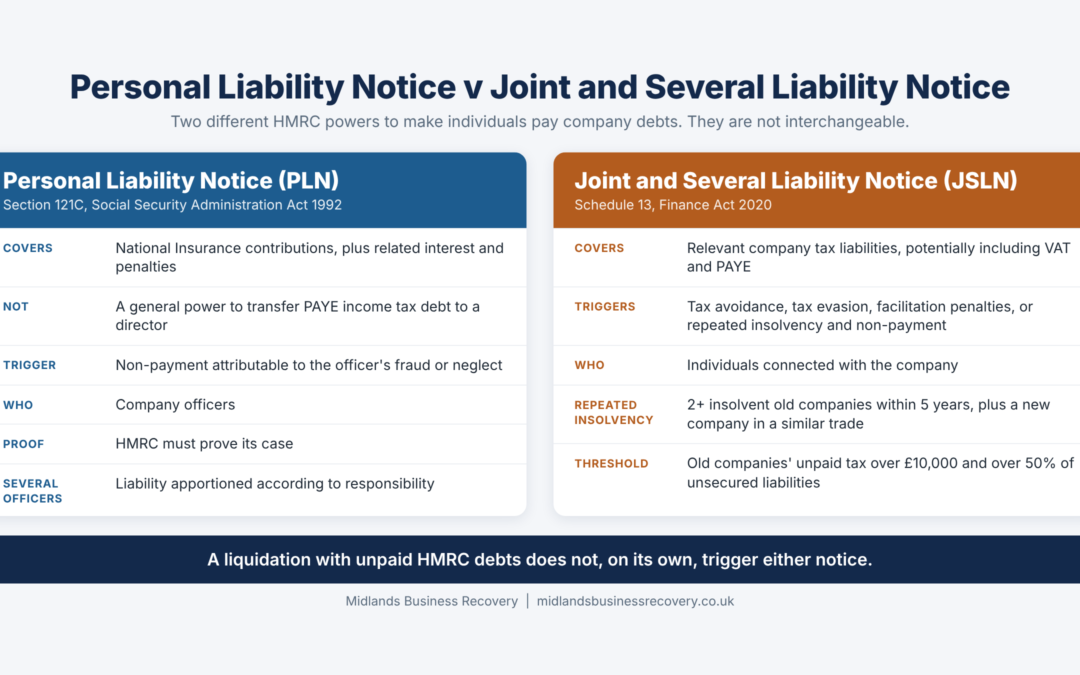
Under section 121C of the Social Security Administration Act 1992, HMRC can issue a Personal Liability Notice (PLN) to a company officer where non-payment of National Insurance contributions is attributable to that person’s fraud or neglect.
A crucial distinction: this PLN concerns National Insurance contributions, including relevant interest and penalties. It isn’t a general power to transfer ordinary PAYE income tax debt to a director.
HMRC must prove its case. Its published practice focuses on fraud or serious neglect, not every company that misses a payment.
Warning signs include prolonged non-payment while directors are paid, contributions knowingly used to finance trading, or similar failures elsewhere.
Where several officers are culpable, HMRC can apportion liability according to their responsibility.
See HMRC’s National Insurance Manual.
Joint and Several Liability Notices: a different power
Schedule 13 to the Finance Act 2020 allows HMRC, where statutory conditions are met, to issue a Joint and Several Liability Notice (JSLN) to individuals connected with a company.
These notices can arise from tax avoidance, tax evasion, penalties for facilitating avoidance or evasion, or repeated insolvency and non-payment.
Unlike the National Insurance PLN, the JSLN regime can cover relevant company tax liabilities, potentially including VAT and PAYE.
A liquidation with unpaid HMRC debts does not, on its own, trigger a JSLN.
Repeated insolvencies and the new company
Imagine someone runs two companies that fail owing substantial tax, then starts a similar business in a third.
For the repeated insolvency route, the law looks at connections with at least two insolvent old companies within five years, a new company carrying on a similar trade, and relevant connections with that new company.
The old companies’ unpaid tax must exceed both £10,000 and 50% of their unsecured creditor liabilities.
A valid notice can create personal exposure to unpaid tax from the old companies and relevant liabilities of the new one, including liabilities arising during the statutory period.
These are targeted provisions, not a blanket prohibition on starting again after failure.
See HMRC’s repeated insolvency guidance.
What about VAT fraud penalties?
Section 61 of the Value Added Tax Act 1994 has been repealed and replaced by Schedule 24 to the Finance Act 2007. Under paragraph 19 of Schedule 24, where a company is liable to a penalty for a deliberate inaccuracy in a VAT return and that inaccuracy was attributable to an officer of the company, HMRC can make that officer personally liable for such portion of the company’s penalty as it specifies, up to 100%.
That isn’t the same as automatically transferring all unpaid VAT to them.
See HMRC’s Compliance Handbook guidance on officers’ liability for penalties.
What should directors do now?
Start with the cashflow, not the fear of a notice.
Separate VAT, PAYE income tax and National Insurance in the creditor schedule. Bring returns up to date, identify why arrears arose and prepare a realistic 13-week forecast.
If the business is viable, consider refinancing, cost reductions and a supported Time to Pay proposal. If not, consider an orderly cessation, business sale or formal insolvency before more liabilities accumulate.
Related reading: Directors’ Duties: The First 7 Days After You Realise Insolvency Is Likely, Directors’ Duties When a Company Is Insolvent and Choosing the Right Rescue or Insolvency Option.
If HMRC issues a PLN or JSLN, check the statutory conditions, calculation and review or appeal rights immediately. Deadlines matter.
Takeaway checklist
- Separate VAT, PAYE and National Insurance arrears.
- Reconcile returns, payments and HMRC statements.
- Identify why each debt arose and when.
- Review director payments and connected-party transactions.
- Check previous company failures and similar new businesses.
- Prepare a credible 13-week cashflow.
- Consider rescue, refinancing or orderly closure.
- Get specialist advice promptly if a personal notice arrives.
Final thought
An unpaid HMRC bill is not automatically a director’s personal debt.
But limited liability isn’t protection against every form of misconduct or repeated misuse of insolvency.
My job is to establish the facts, assess whether the business can be saved and help directors make defensible decisions before matters deteriorate.
Meta description
Can HMRC make directors personally pay VAT, PAYE or National Insurance arrears? Paul Brindley explains PLNs, joint and several liability notices and practical steps.
Hashtags
#HMRC #VATArrears #PAYE #NationalInsurance #DirectorsLiability #CompanyInsolvency #BusinessRescue