
A creditor has told you that, unless you pay in full, they will issue a winding-up petition against your company. Perhaps it is HMRC. Perhaps it is a supplier who has run out of patience. You know the company cannot pay everyone, and you suspect it may have to close.
Your first questions are usually personal ones. Am I going to be blamed? Will I have to pay anything myself? What happens to the staff? Can I still choose who deals with the company, or will the court take that out of my hands?
There is another question that rarely gets asked early enough: if the company is going to be wound up anyway, how much will the route itself cost, and who ends up paying for it?
The answer can be surprising. A liquidation ordered by the court carries fixed government charges of £13,200 before a single creditor is paid, on top of the costs of the petition itself. Those charges come out of the same pot of money that would otherwise go to the creditors, including, quite possibly, you if you have lent the company money or guaranteed its debts.
This article is for directors of limited companies in England and Wales. It explains the two main ways an insolvent company is closed, what each costs, who pays at each stage, and why getting advice before a petition is presented can make a real difference to the outcome for everyone, including you.
1. The two routes in plain English
Liquidation means closing a company down: its assets are sold, the money is used to pay its debts as far as it will go, its affairs are investigated and the company is then dissolved, meaning it ceases to exist.
Compulsory liquidation is liquidation ordered by the court. It usually starts when a creditor who is owed at least £750 presents a winding-up petition, which is a formal application asking the court to wind the company up because it cannot pay its debts. If the court agrees, it makes a winding-up order. The Official Receiver, a civil servant within the Insolvency Service, then becomes liquidator, at least to begin with.
A creditors’ voluntary liquidation (CVL) is liquidation started by the company itself. The directors recognise the company is insolvent, the shareholders pass a resolution to wind it up, and a licensed insolvency practitioner is appointed as liquidator. The creditors are told, given information about the company’s position and have the right to choose a different liquidator if they wish.
Both routes end with the company closed, the assets sold and the directors’ conduct examined. The difference lies in who starts it, who is in charge at the beginning, how much it costs and, often, how the director is treated along the way.
For a fuller explanation of the voluntary route, see my article Creditors’ Voluntary Liquidation (CVL): A Director’s Guide to Starting Over.
2. What the petitioning creditor pays up front
The creditor who presents a winding-up petition, known as the petitioning creditor, must pay money before the court will even list the case. In England and Wales, the government payments are currently:
- Court fee for presenting the petition: £352
- Official Receiver’s deposit: £2,600
- Total initial government payments: £2,952
On top of that, the creditor will usually pay a solicitor to prepare the petition, have it served on the company, advertise it in The Gazette (the official public record) and attend the hearing. Those legal costs vary, but several thousand pounds is not unusual, and more if the company disputes the debt.
The £2,600 deposit is often misunderstood. It is not an extra fee on top of the Official Receiver’s charges. It is security, an advance payment towards the Official Receiver’s administration fee, which is used if the company’s assets are not enough to cover that fee.
The petitioning creditor can often ask for its costs to be paid out of the company’s assets if a winding-up order is made. But that only helps if there are assets to pay them from. If the company has little or nothing, the petitioner can end up losing the deposit and its legal costs as well as the original debt.
That is worth knowing from the director’s side too. A creditor who understands this may be open to a conversation about a voluntary route, particularly if it is told early and given honest information.
3. What the company’s assets pay after a winding-up order
Once the court makes a winding-up order, the Official Receiver’s statutory charges are taken from the company’s assets. These are fixed by law, not negotiated:
- Official Receiver’s administration fee: £6,000
- Official Receiver’s general fee: £7,200
- Total: £13,200
In addition, the Official Receiver can charge a realisation fee of 15% of the value of assets it recovers while acting as liquidator. A realisation simply means turning an asset into cash, such as selling a vehicle or collecting a debt.
These charges still apply where the creditors later replace the Official Receiver with an independent insolvency practitioner, although they can only be paid if the estate has enough money. If a private insolvency practitioner does take over, their own fees and expenses are additional.
The creditors in a compulsory liquidation have no say over the Official Receiver’s fees. They are set by statute and taken in priority to what the creditors receive.
4. How a CVL differs, and what it still costs
A CVL normally avoids the Official Receiver’s £13,200 of statutory charges and avoids the cost of a winding-up petition altogether.
It is not free. There will be the insolvency practitioner’s fees for helping the directors prepare the statement of affairs (a formal list of the company’s assets and debts), the liquidator’s fees, statutory advertising, bonding and other expenses, the cost of investigating the directors’ conduct and, sometimes, substantial legal costs if claims need to be pursued.
The liquidator’s fees in a CVL are approved by the creditors, who can question them, and they are reported on regularly. That is a different position from the fixed Official Receiver charges in a compulsory liquidation.
So the honest comparison is between the total likely cost of each route in the particular case, not between an expensive compulsory liquidation and a cheap CVL. In some cases the difference will be modest. Where a voluntary liquidation would achieve the same recoveries from the assets, though, the saving to creditors can be considerable.
5. A worked example of what the extra costs can mean
These figures are entirely illustrative.
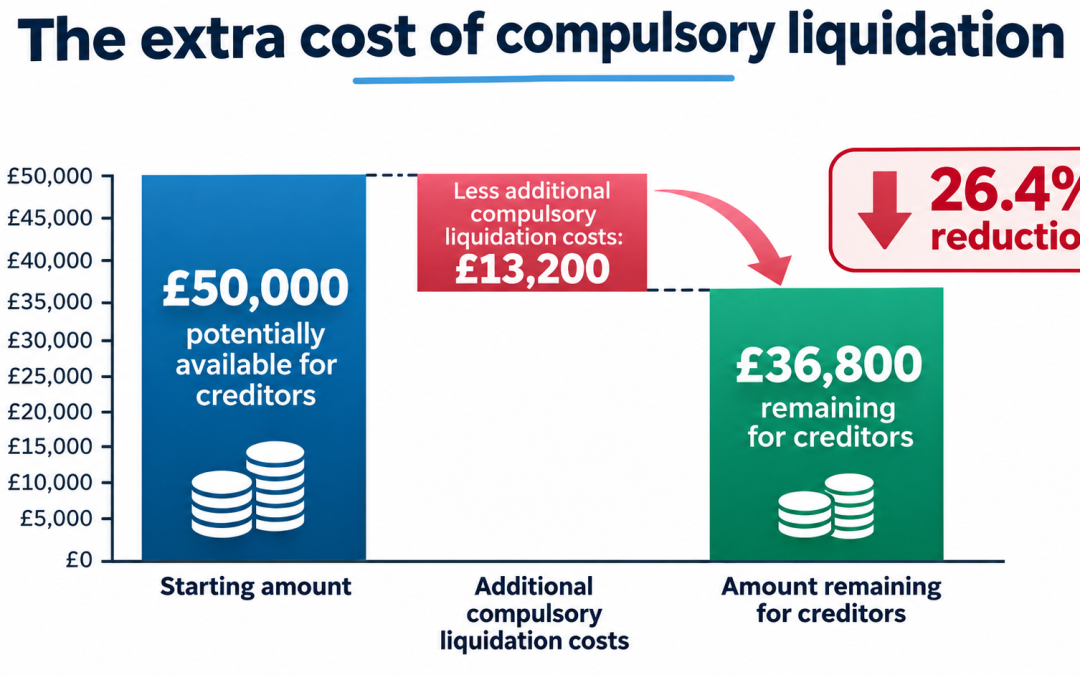
Suppose that, after the costs both routes would share and after any claims that rank ahead of ordinary unsecured creditors, £50,000 would be available to share among those unsecured creditors.
An extra £13,200 of Official Receiver charges would reduce that to £36,800, assuming there are enough funds and the recoveries are otherwise the same. That is a 26.4% reduction in the money available for those creditors.
Now add, say, £3,000 of petition costs being paid out of the assets. The pot falls to £33,800, a reduction of 32.4%.
If you are a creditor yourself, perhaps because you lent the company money or are owed unpaid salary, that is your money too. And if you have personally guaranteed a debt, every pound the guaranteed creditor does not recover from the company is a pound they may look to you for.
6. What happens to you as a director in a compulsory liquidation?
Once a winding-up order is made, your powers as a director end. You can no longer run the company, sign its cheques or deal with its assets.
The Official Receiver will contact you. You will usually be asked to complete a detailed questionnaire, provide the company’s books and records, prepare or help prepare a statement of affairs and attend an interview. These are legal duties, not requests. Failing to co-operate can lead to further action.
The Official Receiver must investigate why the company failed and report on the directors’ conduct to the Insolvency Service. That does not mean you have done anything wrong. Most investigations find an ordinary commercial failure. But you will not have chosen the person doing the investigating, and the process can feel impersonal.
In a CVL the liquidator has the same duty to investigate and report on conduct. The questions are much the same. The difference is that the directors have usually been involved in the decision to liquidate, have had advice beforehand and have had the chance to present the company’s records in good order.
7. The bank account and section 127: why a petition changes everything
Many directors do not realise how much a petition changes the position even before any hearing.
Under section 127 of the Insolvency Act 1986, if a winding-up order is made, any disposition of the company’s property after the date the petition was presented is void unless the court orders otherwise. A disposition means any transfer of the company’s money or assets, including ordinary payments out of the bank account.
In practice, once a petition is advertised, banks commonly freeze the company’s account to protect themselves. Wages, suppliers and rent may suddenly be impossible to pay. A company that might have traded for a few more weeks while an orderly closure was arranged can stop overnight.
It also means that, once the petition has been presented, paying the petitioning creditor to make the petition go away is not the simple fix it appears. The payment itself is a disposition. If a winding-up order is made anyway, perhaps because another creditor takes over the petition, the payment can be challenged and recovered. Directors who authorised payments after the petition was presented may find themselves asked to explain them.
A director can apply to the court for a validation order, which approves particular payments in advance, but that needs evidence, legal costs and time. For more on the timeline, see my article HMRC Winding-Up Petitions: The Timeline, the “Information Gap”, and What Happens to Your Bank Account.
8. Can you still choose a CVL once a petition has been presented?
Yes, the shareholders can still resolve to put the company into voluntary liquidation after a petition has been presented. But it does not make the petition disappear.
The petition remains before the court. The petitioning creditor can still ask for a winding-up order, and the court will take account of the creditors’ views, particularly any concerns about independence or the directors’ conduct. Section 127 continues to apply to dispositions after the petition date.
Where a properly run CVL is in place and the creditors are content, the court may be persuaded that a compulsory order would add cost without benefit. Where creditors have genuine concerns, it may make the order anyway. Either way, there are legal steps and costs that would have been avoided if advice had been taken before the petition was issued.
This is the single biggest practical point in this article. The time to consider a voluntary liquidation is when you first realise the company cannot pay its debts, or at the latest when a creditor first threatens a petition. Not after the petition has been served and advertised.
My earlier article A Winding-Up Petition Has Arrived… What Should Directors Do Now? deals with the steps once one has arrived.
9. When a CVL is not the better answer
I would not want any director to read this and assume a voluntary liquidation always saves money or always suits creditors. It does not.
A petitioning creditor may have good reasons to prefer the court route. It may be worried that assets are being moved out of the company, that the directors are not being straight about what has happened, or that a liquidator chosen with the directors’ involvement will not be independent enough. In some cases the court’s powers, such as the appointment of a provisional liquidator to protect assets urgently, are genuinely needed.
Creditors in a CVL do keep statutory rights. They can nominate a different liquidator, ask questions, challenge fees and form a committee to oversee the liquidation. An insolvency practitioner also has professional and ethical duties of independence regardless of who first made contact.
It is also worth remembering that the book value of assets in the accounts often bears little relation to what will actually be recovered. A director’s loan account showing £40,000 owed to the company is only worth what can be collected from the director. A possible legal claim against a third party is only worth what it would realistically achieve after costs. The realistic recoveries matter far more than the figures on the balance sheet when comparing the two routes.
10. When does it become your personal problem?
Liquidation does not, by itself, make a director personally liable for the company’s debts. A limited company’s debts are its own. But several things can follow you whichever route is taken.
Personal guarantees. If you have guaranteed a bank loan, an overdraft, a lease, a finance agreement or a supplier account, the creditor can pursue you for any shortfall. Liquidation is often what triggers the claim. The higher the costs of the liquidation, the larger the shortfall is likely to be.
An overdrawn director’s loan account. If you have taken more out of the company than you put in, the liquidator, whether the Official Receiver or an insolvency practitioner, will treat that as a debt you owe the company and will seek to collect it. See Overdrawn Directors’ Loan Accounts in Liquidation: The Debt That Does Not Disappear.
Wrongful trading. If a director knew, or should have concluded, that there was no reasonable prospect of avoiding insolvent liquidation and did not take every step to minimise the potential loss to creditors, the court can order a personal contribution. Continuing to trade while a petition hangs over the company, and while debts grow, is the kind of conduct a liquidator will look at.
Misfeasance. This means misuse of company money or property, or a breach of a director’s duties. A director can be ordered to repay or compensate the company.
Preferences. If, before the liquidation, the company paid a creditor in a way that put them in a better position than others, and the company wanted to do that, the payment can be reversed. Paying off a loan you personally guaranteed, or repaying money you lent the company yourself, receives particular scrutiny.
Personal tax liability. HMRC has limited powers to make directors personally liable for certain company taxes, for example National Insurance where non-payment was due to fraud or neglect. See VAT and PAYE Arrears… When HMRC Can Make Directors Personally Pay.
Disqualification. If a director’s conduct is found to make them unfit, they can be disqualified from acting as a director for between two and fifteen years. That is a restriction on management, not an order to pay the debts, though compensation orders are also possible.
Re-using the company name. After an insolvent liquidation, a director of the company in the previous year is generally restricted from being involved with another business using the same or a similar name for five years, unless one of the legal exceptions applies. This applies in both a CVL and a compulsory liquidation. See Re-use of a Company’s Prohibited Name post Insolvent Liquidation.
None of these depends on which route is chosen. But the route can affect how much is recovered for creditors, and therefore how hard guaranteed creditors and the liquidator look at you to make up the difference.
11. The awkward cases
You are also a creditor. If you have lent the company money, you are usually an unsecured creditor like any other. Every extra pound of liquidation cost reduces what you may get back. Do not repay yourself ahead of others once the company is in trouble.
You are a guarantor. As above, the guaranteed creditor will look to you for the shortfall. That gives you a personal interest in the liquidation costing less, but it must not influence which creditors the company pays before it closes.
Your pension scheme is the landlord. Many owner-managers hold the business premises through a SSAS (a Small Self-Administered Scheme, an occupational pension scheme for business owners) or a SIPP (a Self-Invested Personal Pension). If the company owes rent to your own pension scheme, the scheme is a creditor. If you are also a trustee, you have duties to the scheme as well as to the company. Do not waive the rent, change the lease or let the company keep using the premises rent-free without specialist advice. A liquidator will look at those arrangements closely.
A connected company owes or is owed money. Balances between your companies, or with a company owned by a family member, will be scrutinised. Moving assets or contracts to a connected business before liquidation, at less than their value, can be challenged as a transaction at an undervalue.
You were thinking of striking the company off. Striking off is simply removing the company from the register at Companies House. It is not a way to deal with an insolvent company’s debts, and once a creditor is pursuing a petition it is not a realistic route at all. Creditors can object, and a struck-off company can be restored to the register.
12. What happens to your staff?
In either route, employees are normally dismissed when the company stops trading. Eligible employees can claim statutory redundancy pay, a limited amount of arrears of wages, holiday pay and notice pay from the government’s Redundancy Payments Service, subject to statutory limits and conditions.
The liquidator provides the information the service needs to process those claims. Where a CVL is arranged in advance, the records are usually ready on day one and claims can be processed promptly. Where a company stops suddenly because the bank account is frozen after a petition is advertised, staff can be left uncertain for longer, and payroll and holiday records may be harder to gather.
A director who is also an employee may be able to claim as well, but must show genuine employee status, which is not automatic for a shareholder-director.
Whichever route is taken, your staff deserve honest and timely information. Planning the closure rather than having it forced on the company is usually kinder to them.
13. A note for the creditor thinking of petitioning
If you are a business owed money by a company you believe is insolvent, the same arithmetic applies from your side.
You will pay at least £2,952 in government payments, plus legal costs, before the hearing. If the company has assets, the Official Receiver’s £13,200 of charges will come out of them before you see anything. If it has no assets, you may lose the deposit and your legal costs as well as your debt.
Before issuing a petition, it can be worth asking whether the directors would agree to an orderly CVL with an independent liquidator, and whether that would leave more for you and the other creditors. A petition is still the right step where there are real concerns about conduct or assets, but it should be a decision, not a reflex.
14. What I would do this week if I were you
- If a creditor has threatened a petition, or sent a statutory demand, note the date and take advice straight away. Do not wait for the petition to be served.
- Get an up-to-date list of what the company owns and owes, including amounts owed to and by you personally, and any personal guarantees you have given.
- Prepare a short cashflow forecast for the next few weeks to see honestly whether the company can pay its debts as they fall due.
- Check whether any petition has already been presented or advertised against the company. If it has, assume the bank may freeze the account and take advice before making any payments.
- Gather the company’s books, bank statements, payroll and VAT records in one place. You will need them whichever route is taken.
- Look at the director’s loan account balance and work out whether you owe the company money.
- If your pension scheme or a connected company is a landlord, lender or creditor, list those arrangements and get specialist advice before changing any of them.
- Hold a directors’ meeting, record the position and the advice received, and record the decision about what happens next.
- If the company is insolvent and has no realistic way back, ask a licensed insolvency practitioner to compare the likely costs and outcomes of a CVL against waiting for a compulsory order.
- Keep your staff informed honestly once a decision has been made.
Things I would not do
I would not pay the threatening creditor in full to make the problem go away if other creditors are left unpaid. That may be a preference, and if a petition has already been presented the payment may be void.
I would not repay my own loan to the company, or pay off a debt I have personally guaranteed, ahead of other creditors.
I would not move assets, contracts, customers or equipment to another company before taking advice.
I would not ignore a petition in the hope it will be dismissed, or keep trading and taking customer deposits while it is pending.
I would not try to strike the company off as a way of avoiding creditors.
And I would not assume that a voluntary liquidation is automatically cheaper or better. It needs to be compared properly.
Takeaway checklist
- A compulsory liquidation carries £13,200 of Official Receiver charges, plus a possible 15% fee on assets recovered.
- The petitioning creditor pays £2,952 to the government up front, plus legal costs.
- Those costs reduce the money available for all creditors, including you if you are owed money.
- Higher costs can mean a larger shortfall on debts you have personally guaranteed.
- A CVL avoids the Official Receiver charges and petition costs, but still has its own fees and expenses.
- Once a petition is presented, section 127 makes later payments vulnerable and banks often freeze accounts.
- A CVL after a petition does not remove the petition automatically.
- Your personal risks, such as guarantees, loan account and conduct, follow you whichever route is taken.
- The time to take advice is before the petition, not after it.
Final thoughts…
The choice between compulsory and voluntary liquidation is not simply about how quickly a company is closed. It is about how much money remains for creditors after the costs of getting there, and about how the closure is handled for the director and the staff.
A voluntary liquidation is not always the right answer, and it is never free. But where it would achieve the same recoveries, an orderly CVL can leave creditors thousands of pounds better off than a court-ordered winding up, and it lets the director take control of a difficult situation rather than have it taken from them.
If a creditor is threatening a petition, or you are a creditor considering issuing one, I would much rather talk to you before anyone pays the court fee and the deposit. You can contact me through Midlands Business Recovery to discuss the options in confidence.
Meta description
Facing a winding-up petition? Paul Brindley explains the Official Receiver’s £13,200 fees, who really pays them and when a CVL may leave more for creditors.
Hashtags
#Insolvency #CompulsoryLiquidation #CVL #WindingUpPetition #DirectorsDuties #OfficialReceiver #BusinessRescue #CompanyInsolvency